Viewing entries in
UN

 IFOR joins in a call to the UN member States to "MOVE THE MONEY OUT OF MILITARY, TO FOOD"

Comment

IFOR joins in a call to the UN member States to "MOVE THE MONEY OUT OF MILITARY, TO FOOD"


IFOR co-sponsored, together with other 13 NGOs, an oral statement on the Right to Food which was delivered by Associazione Papa Giovanni XXIII during the 46th session of the UN Human Rights Council.

The statement refers as well to the last encyclical of Pope Francis "Fratelli tutti" ("All brothers"), on Fraternity and Social Friendship, and reinforces the call to

"convert the money spent on weapons and other military expenditures in a global fund that can finally put an end to hunger and favour development in the most impoverished countries".


46th Regular Session of the Human Rights Council, 22 February – 23 March 2021

Item 3: ID with Special Rapporteur on the right to food


Joint oral statement delivered by: Associazione Comunità Papa Giovanni XXIII (APG23)

Check against delivery


Madam President,


APG23 and 14 co-signing NGOs welcome the report of the Special Rapporteur on the right to food in which he highlights the issues that will inform his future thematic reports.1

According to the UN Policy Brief on the Impact of COVID-19 on Food Security and Nutrition from June 2020 “Prior to the onset of this pandemic, more than 820 million people were already identified as chronically food insecure.” 2 We expect that the pandemic will push more children and adults into food insecurity and hunger around the world, undermining the efforts to achieve SDG2 and, more worryingly, increasing malnutrition-related deaths.

In his speech for the last World Food Day in October 2020, Pope Francis remarked: “Hunger is not only a tragedy for humanity, but also a shame. It is caused largely by an unequal distribution of the fruits of the earth, compounded by a lack of investment in the agricultural sector, the consequences of climate change and the increase in conflicts in various areas of the planet.”3

In view of the incoming Food Systems Summit, we hope that the discussion on food systems will focus on putting human rights at their core, addressing inequalities, promoting accountability and ensuring that markets serve social needs above profits.

We concur with the proposal of Pope Francis in the last encyclical “On Fraternity and Social Friendship” to convert the money spent on weapons and other military expenditures in a global fund that can finally put an end to hunger and favour development in the most impoverished countries.

In this regard, we urge the Member States to make concrete actions that are needed now more than ever. The future of the next generations is in our hands, we must do our part. Thank you!


image (6).png

Fratelli tutti (All Brothers) is the third encyclical of Pope Francis , subtitled "on fraternity and social friendship". In the document, Francis states that the way theCOVID-19 pandemic was managed by world countries has shown a failure in global cooperation. The encyclical calls for more human fraternity and solidarity, and is a plea to reject wars.

The document was signed on October 3rd 2020, on the occasion of Pope Francis's visit to the tomb of his namesake, Saint Francis of Assisi, and was published the following day on the saint's feast day. You can download the encyclical here.

Comment

 IFOR joins a statement on the violation of human rights of migrants and refugees in the Balkan Route: 46th UN HRC

Comment

IFOR joins a statement on the violation of human rights of migrants and refugees in the Balkan Route: 46th UN HRC

IFOR has joined a statement, at the ongoing 46th session of the UN Human Rights Council, on the continued systematic and institutionalized violation of the rights of migrants crossing the Balkan route to Europe.

balkan route.jpg

The statement has been delivered during the General Debate with the High Commissioner on human rights Michelle Bachelet on March 1st, by Associazione Comunità Papa Giovanni XXIII, following the presentation of reports by the High Commissioner.

"Madam President,

APG23 and 10 co-signing NGOs are concerned about the continued systematic and institutionalised violation of the rights of migrants crossing the Balkan route to Europe.
We refer to thousands of persons who are spending the freezing Balkan and Greek winters in camps, often lacking the fundamental rights. According to reports of NGOs directly monitoring the situation, including some co-signatories of this statement, people in camps live in dreadful conditions lacking heating, electricity and proper sanitation. This causes the insurgence of illness and degradation of living, and exposes several persons to inhuman and degrading treatments. Indeed, there are remarkably high cases of self-harm and suicide attempts inside the camps, even among children.


Furthermore, the current COVID19 health crisis has often been used as an instrument of pressure by the host countries against both migrants and NGOs, creating a strong criminalisation of those who denounce the current situation. Permissions to leave the camps are often denied even if migrants present evidence of serious proven health problems. At the same time, it is increasingly difficult for NGOs to support migrants. The current law of some host countries foresees heavy fines for helping migrants and some NGOs have even been accused by the authorities of abetting illegal immigration after reporting pushbacks by the coast guard.


Finally, other illegal practices continue to be carried out, such as the violent pushbacks of migrants on land and sea, as well as the registration of people as adults even if they are minors, to reduce the State's reception costs.


We believe that time has come to put an end to these human rights violations, which have taken place for too long and that risk becoming even more systematic trends perpetrated with impunity. It is critical to find long-term solutions and reflect on the underlying reasons and policies that have triggered the situation.
Thank you!"

The statement is available here.

You can watch the reporting of the High Commissioner on the situation of human rights at this link.

Comment

IFOR takes the floor at 46th UN HRC during the general debate with the High Commissioner for Human Rights Ms. Michelle Bachelet

Comment

IFOR takes the floor at 46th UN HRC during the general debate with the High Commissioner for Human Rights Ms. Michelle Bachelet

image.png

IFOR is currently participating in the 46th session of the UN Human Rights Council which is in remote modality due to the pandemic. Today program of work included the general debate with the High Commissioner for Human Rights and following the States representatives, NGOs with Consultative Status have been able to take the floor.

IFOR referred to some concerning local situations such as Colombia, Eritrea and Western Sahara and then addressed the issues of criminalization of solidarity and nuclear disarmament


Human Rights Council, 46th Session

Geneva, 26th February 2021 

Item 2: General Debate

Oral statement delivered by the International Fellowship of Reconciliation.


Madam High Commissioner,

IFOR thanks you and your office for the reports.

We are particularly concerned by the situation in Eritrea and in the region and by the lack of collaboration as also highlighted, yesterday, by the new Special Rapporteur[1] and share a deep concern for the risk and danger faced by young people who refuse to serve in the National Service.

We welcome the recommendations which have been listed in your report on Colombia[2] and highlight the importance to guarantee a comprehensive intervention by the State to reduce the violence and not just an increase in the military presence.

 We are alarmed by the increasing cases of criminalization of solidarity[3] with individual cases of people being charged with aiding and abetting illegal immigration because they provide first assistance to migrants or rescue them, whether at sea, in the mountains or in the middle of forests.

 Western Sahara, the last colony in Africa[4], continues to be a pending decolonization case. International Law needs to be implemented.

IFOR restate the call made a few months ago “on the governments in the region and around the world to contribute to a peaceful  solution of the conflict and the implementation of the fundamental rights of the Saharawi people”[5].

We would like to conclude with a positive note: nuclear weapons are finally banned!

We welcome the enter into force of the UN Treaty on the prohibition of nuclear weapons (TPNW)[6], on January 22nd 2021[7].

Thank you.


  1. Oral update of Mohamed Abdelsalam Babiker, Special Rapporteur on the situation of human rights in Eritrea, at the 46th HRC on February 24th 2021. https://www.ohchr.org/EN/NewsEvents/Pages/DisplayNews.aspx?NewsID=26795&LangID=E

  2. A/HRC/46/76.

  3. In 2019 the Red Cross EU Office released a statement regarding the soaring of the criminalisation of solidarity in Europe. https://redcross.eu/latest-news/the-eu-must-stop-the-criminalisation-of-solidarity-with-migrants-and-refugees 

    Some recent individual cases:
    Gian Andrea Franchi and Lorena Fornasir: https://www.avvenire.it/attualita/pagine/si-preso-cura-dei-migranti-sotto-accusa-nonno-andrea

    Carola Rackete: https://theconversation.com/sea-watch-3-captain-arrested-eu-complicit-in-criminalising-search-and-rescue-in-the-mediterranean-119670

    Sean Binder and Anouk Van Gestel: https://www.ceps.eu/ceps-events/criminalisation-of-solidarity-how-to-protect-the-right-to-help-migrants-and-refugees/

  4. It is on the UN list of Non-Self-Governing Territories since 1963.

  5. IFOR has released a statement on the situation in Western Sahara on November 13th 2020 http://www.ifor.org/news/2020/11/13/ifor-statement-on-the-current-situation-in-western-sahara. Another one was released on December 14th 2020 http://www.ifor.org/news/2020/12/14/smlf3m85b4eq2r7kexpxd76zzgvoi5.

  6. https://www.un.org/disarmament/wmd/nuclear/tpnw/

  7. https://www.icanw.org/tpnw_enters_into_force


IFOR has released a public statement regarding Western Sahara on November 13th 2020, the day before the truce was broken in the region. You can read the original statement here.

A second statement has been published December 14th 2020 on the U.S. recognition of Moroccan sovereignty over Western Sahara and on the primacy of fundamental rights and international law. You can read the original statement here.

IFOR has a long standing engagement for nuclear disarmament and on January 22nd 2021 has organized a new Day of Action to join activists worldwide to celebrate the entering into force of the UN nuclear ban Treaty adopted on July 7th 2017 by the UN General Assembly. The Treaty reached its 50th ratification on October 24th 2020, International UN Day.

You can watch here, the video message of the president of IFOR which has been released for the occasion.

You can read more about the Day of Action here and discover some actions from IFOR members published on our Facebook page.

Comment

IFOR speaks on the tragedy of the Eritrean refugees in the Tigray region and to the Eritrean indefinite National Service;  46th session of the UN Human Rights Council.

Comment

IFOR speaks on the tragedy of the Eritrean refugees in the Tigray region and to the Eritrean indefinite National Service; 46th session of the UN Human Rights Council.

International Fellowship of Reconciliation - IFOR is participating in the 46th session of the UN Human Rights Council which started on February 22nd.

Today, February 24th, IFOR Main representative to the UN in Geneva delivered a statement in the plenary of the Council, during the interactive dialogue with the new Special Rapporteur on the situation of human rights in Eritrea, Mohamed Abdelsalam Babiker, who has been appointed in September 2020.

image (4).png

Dr. Mohammed Abdelsalam Babiker, originally from Sudan, is an Associate Professor of International Law, Dean of the School of Law at the University of Khartoum, and founding Director of its Human Rights Centre. He teaches human rights law, refugee law, international humanitarian law, and international criminal law among others. Dr. Babiker is also a practicing lawyer and conducted international investigations in many countries in the Horn of Africa in the areas of human rights and international humanitarian law.

In addition to Dr. Babiker’s academic qualifications, he has extensive experience working with international human rights organizations and institutions, including the United Nations (UN) and the African Union (AU).

In December 2017, he was appointed by the United Nations Secretary-General as Humanitarian Expert with the Somalia and Eritrea Monitoring Group. In December 2018, he was also appointed as the Humanitarian Expert with the Panel of Experts on Somalia. Dr. Babiker also worked as a Legal Advisor and a Human Rights Officer with UN and AU peacekeeping operations, as well as a number of UN agencies.

-Information available at the OHCHR website


The Special Rapporteur presented to the Council his oral update on the situation of human rights in Eritrea which focused on the human rights of Eritrean refugees and asylum seekers in the context of the ongoing Tigray crisis in Ethiopia and the progress made in relation to the benchmarks set out in the reports of his predecessor. You can find the complete text of the oral update here.

IFOR took the floor after the States statements and referred to the humanitarian tragedy of the Eritrean refugees in the Tigray area and to the issue of the indefinite National Service.


"Madam President,

 The International Fellowship of Reconciliation thanks the Special Rapporteur for his oral update.

The current situation in the region is dramatic, as reported also from our local partner organizations.

Refugee camps under international protection in the Tigray region, including schools, clinics and residential areas, have been systematically targeted and destroyed with the purpose of hindering their future usage[1]. In particular, the Hitsats and Shimelba refugee camps, which hosted refugees coming from Eritrea, have been under attack. The UNHCR acknowledges that 20,000 refugees are unaccounted for. Only around 3,000 refugees from Shimelba and Hitsats camps found their way to the other two refugee camps in the South of Tigray, Mai-Aini, and Adi-Harush, with an estimated 10.000 refouled to Eritrea. UNHCR warns that thousands of Eritrean refugees are still in need of urgent assistance[2]

We restate the concern regarding Eritrean migrants and refugees who often flee from the system of an indefinite National Service which presents practices that in many cases amount to forced labour.

We call on the international community to protect refugees and to withdraw from practices which reinforce such a system.

Thank you."

[1] https://www.vice.com/en/article/93wmbz/refugee-camps-in-ethiopia-appear-to-have-been-systematically-destroyed

[2] https://www.voanews.com/africa/un-eritrean-refugees-tigray-face-humanitarian-crisis
Statement attributable to the UN High Commissioner for Refugees Filippo Grandi on the situation of Eritrean refugees in Ethiopia’s Tigray region. https://www.unhcr.org/news/press/2021/1/600052064/statement-attributable-un-highcommissioner-refugees-filippo-grandi-situation.html"


The statement can be downloaded here.

You can watch the Interactive Dialogue here.

The UN briefing on the Interactive Dialogue referred to in this article is available here.

Comment

IFOR STATEMENT ON THE CURRENT SITUATION IN WESTERN SAHARA

Comment

IFOR STATEMENT ON THE CURRENT SITUATION IN WESTERN SAHARA

STATEMENT ON THE CURRENT SITUATION IN WESTERN SAHARA 

Today, on November 13th 2020, several media outlets have reported that the Moroccan army launched an op eration near the border crossing at Guerguerat against a group of Saharawi protesters.1 The representatives of  the Saharawi people had previously stated that any such Moroccan action would be considered an aggression  to which they would respond, and that this would mean the end of the ceasefire agreement between the parties.2 While early reports are still unclear, the developments today represent a clear threat of an outbreak of a new  war. 

In 1991, the United Nations and the international community made a promise to the Saharawi people that a  referendum would be organized, and that they freely and fairly would get to decide their own fate. 30 years  later, that promise remains unfulfilled. Today’s events demonstrate that a continued status quo and continued  inaction is not sustainable and not acceptable.  

The International Fellowship of Reconciliation (IFOR) was founded over 100 years ago in response to the  horrors of the First World War. Since then, IFOR has taken a consistent stance against war and its preparation.  When people and organizations commit themselves to action, war and conflicts can be prevented and trans formed through nonviolent means.  

Such action is urgent and well overdue. The UN needs to take concrete steps to deescalate the current situation  and demonstrate a serious commitment to renewed negotiations. IFOR welcomes any efforts by the UN to  immediately seek an end to the current military escalation. These efforts must be intensified. Further,  IFOR calls upon the UN Secretary-General António Guterres to without delay appoint a new UN Per 

sonal Envoy for Western Sahara to demonstrate that continued status quo is not acceptable. The position  has been vacant for 18 months. With the vacancy, the main avenue for non-violent engagement between the  parties is closed and the peace process is at a standstill. The immediate appointment of a new Personal Envoy  is the very least that the UN can do to signal to those desiring a non-violent resolution to the conflict that such  a path is still possible. The consequence of continued stalling has been made clear today.  

IFOR also calls on the governments in the region and around the world to contribute to a peaceful  solution of the Western Sahara conflict and the implementation of the fundamental rights of the people  living on those territories. The UN Member States must act in accordance with the UN Charter3and demon strate that continued military escalation is unacceptable. The outbreak of a new war in the region would con stitute a grave risk for people’s lives and livelihoods. The Covid-19 Pandemic has put severe strains on an  already difficult situation and would further complicate any humanitarian and other relief efforts that would  follow a war. It is imperative that this is avoided and that a credible path to a peaceful resolution is established. 


Notes

  1. For example, Al-Jazeera. Morocco troops launch operation in Western Sahara border zone. Retrieved November 13, 2020.  https://www.aljazeera.com/news/2020/11/13/morocco-launches-operation-in-western-sahara-border-zone

  2. Sahrawi Arab Democratic Republic Ministry of Information. Press Release November 9, 2020.  

  3. In particular, Article 1 of the UN Charter: “The purposes of the UN is to maintain international peace and security, and to that end:  to take effective collective measures for the prevention and removal of threats to the peace, and for the suppression of acts of aggression  or other breaches of the peace, and to bring about by peaceful means, and in conformity with the principles of justice and international  law, adjustment or settlement of international disputes or situations which might lead to a breach of the peace”.


Comment

 IFOR reports to the 38th session of the UPR on the right to conscientious objection to military service in Singapore

Comment

IFOR reports to the 38th session of the UPR on the right to conscientious objection to military service in Singapore

IFOR prepared a report on the right to conscientious objection to military service in Singapore. and submitted it to the 38th session Universal Periodic Review of the Human Rights Council.

The session will take place in May 2021 and it will include the review of human rights in Singapore.

The main issue in this Country, related to this topic, is the fact that there is no recognition of the right to conscientious objection to military service in law and practice and thus objectors are prosecuted and detained.

The report submitted by IFOR addressed the non-recognition of the right to conscientious objection, persecution of conscientious objectors, underage recruitment and restrictions on civil society (with particular attention to freedom of opinion and expression, right to peaceful assembly, freedom of association).

Regarding the rights of the child, the document points out that

"Under the Voluntary Early Enlistment Scheme (“VEES”), children who have reached the age of 16 years and 6 months may be voluntarily recruited into the Singapore Armed Forces. Such voluntary recruitment is subject to documentary proof of age, the written consent of a parent or legal guardian, and the fully informed consent of the recruit."

The submission also includes suggested recommendations to change the status quo and ensure human rights.

You can download the complete Report here

You can find more details on the previews UPR of Singapore here


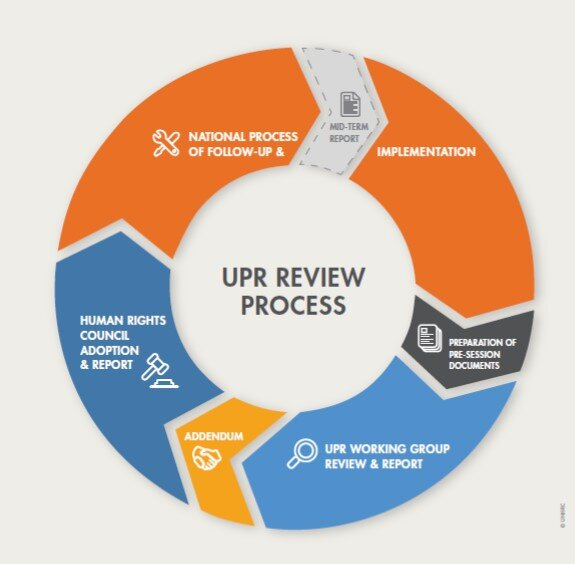
The Universal Periodic Review is a State-driven process, which provides the opportunity for each State to present what actions they have taken to improve the human rights situation in their country and to fulfil their human rights obligations; the State under review will also report on the implementation of the previously accepted recommendations. UN Member States have the possibility to ask questions and make recommendations to the State under review. UPR Working Group consists of the 47 members of the Council, however any member state can take part in the discussion.
The review is based on information provided by the interested State, independent human rights experts and other stakeholders such as NGOs.
NGOs reports and proposed recommendations can be referred to by any of the States taking part in the interactive discussion during the review; it is therefore of vital importance to engage at the UPR and address specific issues which can be therefore part of the dialogue with the country under review.
IFOR focuses in particular on issues related to conscientious objection and to the militarization of society. 

IFOR is currently running a particular conscientious objection project, funded by the Joseph Rowntree Charitable Trust (JRCT), a grant-making Quaker trust. Among the main aims there are research work and redaction of thematic country-based reports to be submitted to the UN for the regular State reviews on human rights.

The right to refuse to kill, although it is a human right, it is not recognized in all countries and many objectors are persecuted.

IFOR is committed to support this right and make a lasting change in society, for peace. JRCT recognizes that "change can take many years to achieve and is willing to take the long view, and to take the risks".

Comment

Comment

IFOR participates in a public statement regarding ECtHR judgment on Russian CO case

ECtHR judgement on Russian CO case disregards 53 years of international human rights standards

On the 7th of September 2020 the Grand Chamber panel of the European Court of Human Rights rejected the request to refer the case of Dyagilev v. Russia (no. 49972/16) to the Grand Chamber, thus rendering the judgement of 10 March 2020 final. In this judgement, by majority of four (4) to three (3), the European Court of Human Rights (Third Section), found that there has been no violation of article 9 of the European Convention of Human Rights in the case of conscientious objector (CO) Maksim Andreyevich Dyagilev, whose application for CO status and alternative civilian service had been dismissed by a military recruitment commission, and subsequently by courts. 

In this judgement, a small majority of judges found that the military recruitment commission “satisfies the prima facie requirement of independence” despite the fact that three out of seven of its members are representatives of the Ministry of Defence. 

In this ECtHR judgement a slim majority disregards all other relevant international and regional human rights standards set by numerous UN and European institutions for more than half a century. 

First of all, in this case the majority of ECtHR judges appear to ignore that “no court and no committee can examine a person’s conscience”, and that “in order to be recognized as a conscientious objector, a declaration setting out the individual's motives should suffice in order to obtain the status of conscientious objector”, as European Parliament’s resolutions have repeatedly stated for over 30 years.i 

Furthermore, the ECtHR disregards the fact that both the UN Human Rights Council, ii and its predecessor, the then UN Commission on Human Rights, iii have, since 1998, welcomed the fact that some States accept claims of conscientious objection as valid without inquiry. In this case, not only was Dyagilev’s claim not accepted without inquiry, but, as pointed out in the dissenting opinion of 3 judges, the “assessment was based on an overly burdensome standard of proof”. 

In this judgement the ECtHR appears to ignore the international and regional human rights standards concerning any applications for conscientious objector status. 

In 1967 the Parliamentary Assembly of the Council of Europe, decided that: “Where the decision regarding the recognition of the right of conscientious objection is taken in the first instance by an administrative authority, the decision-taking body shall be entirely separate from the military authorities and its composition shall guarantee maximum independence and impartiality.”iv [emphasis added] 

Similarly, the then UN Special Rapporteur on religious intolerance, set the relevant standard as long ago as 1986: “The decision concerning their status should be made, when possible, by an impartial tribunal set up for that purpose or by a regular civilian court, with the application of all the legal safeguards provided for in international human rights instruments. There should always be a right to appeal to an independent, civilian judicial body. The decision-making body should be entirely separate from the military authorities and the conscientious objector should be granted a hearing, and be entitled to legal representation and to call relevant witnesses.”v [emphasis added] The same standards continue to be cited today by the UN Special Rapporteur on freedom of religion or belief as the role is named now.vi 

It is obvious that a military recruitment committee with any representatives of the Ministry of Defence, let alone three (3) out of seven (7) members, is not “entirely” separate from the military authorities. Furthermore, insofar it is the military members and not the civilian ones which raise questions of independence and impartiality, as it appears to be accepted by the ECtHR [see Papavasilakis v. Greece, no. 66899/14], a composition which would guarantee “maximum” independence and impartiality should have been one with the minimum [i.e. zero] participation of military members. 

Most importantly, in this case the ECtHR does not take into account the recommendations of the UN Human Rights Committee which, in 2009, urged Russia to “consider placing the assessment of applications for conscientious objector status entirely under the control of civilian authorities.”vii [emphasis added] 

The OHCHR has also adopted a similar standard noting that: “Independent and impartial decision-making bodies should determine whether a conscientious objection to military service is genuinely held in a specific case. Such bodies should be placed under the full control of civilian authorities.”viii 

It is worth noting that this ECtHR judgement, which appears to accept a minority of military members in the bodies examining applications for CO status, contradicts its own rationale on whether even a single member may affect the independence and impartiality of a body. For example, in the case of Canevi and Others v. Turkey, no. 40395/98, which is not related to conscientious objectors, the ECtHR found a violation of Article 6.1 of the European Convention of Human Rights (right to fair trial), because of the participation of a single military member in a tribunal. If even a single (1) military officer affects the impartiality and independence of a tribunal in a case which has nothing to do with the army it is absolutely clear that the same would be true when the issue at stake is directly related to the army as it involves a conscientious objector opposing the army and the military service. 

In conclusion, this year’s ECtHR judgement in the Dyagilev v. Russia case contradicts longstanding international and regional human rights standards concerning the recognition of COs, as well as its’ own broader rationale on independence and impartiality. In any case, the ECtHR may be responsible for the European Convention for Human Rights, but its judgement does not preclude the possibility for Dyagilev himself, as well as other conscientious objectors in similar position, to seek justice at a different level, such the UN Human Rights Committee, for violation of a different treaty, the International Covenant on Civil and Politic Rights. 

This ECtHR ruling, concerning a single case with specific characteristics, adopted by a majority of just one judge, and not examined by the Grand Chamber does not set a general precedent for Russia and cannot annul the growing jurisprudence on the right to conscientious objection to military service. 


Statement published on October 29th 2020 by 

Connection e.V., EBCO-European Bureau for Conscientious Objection, 

IFOR-International Fellowship Of Reconciliation, WRI-War Resisters’ International. 


i European Parliament, Resolution on conscientious objection and alternative service, (Α3-15/89), [known as Schmidbauer Resolution], as published in the Official Journal of the European Communities C291, 13 October 1989, para. Α (page 123) and para. 4 (page 124). See also: European Parliament, Resolution on conscientious objection, (1-546/82), [known as Macciocchi Resolution], 7 February 1983, as published in the Official Journal of the European Communities C 68, 14 March 1983, para. 3 (page 15). 

ii UN Human Rights Council, Resolution 24/17 (A/HRC/RES/24/17), 8 October 2013, para. 7. Available at http://undocs.org/A/HRC/RES/24/17. 

iii UN Commission on Human Rights, Resolution 1998/77, Conscientious objection to military service, 22 April 1998, (E/CN.4/RES/1998/77), para. 2. 

iv Council of Europe, Parliamentary Assembly, Resolution 337 (1967), Right of conscientious objection, para. b2. 

v Report submitted by Mr. Angelo Vidal d Almeida Ribeiro, Special Rapporteur appointed in accordance with Commission on Human Rights resolution 1986/20 of 10 March 1986 (E/CN.4/1992/52), 18 December 1991, para. 185. http://undocs.org/E/CN.4/1992/52. 

vi Rapporteur’s Digest on Freedom of Religion or Belief, p. 45. https://www.ohchr.org/Documents/Issues/Religion/RapporteursDigestFreedomReligionBelief.pdf. 

vii UN Human Rights Committee, Concluding observations on the sixth periodic report of the Russian Federation, (CCPR/C/RUS/CO/6), 24 November 2009, para. 23. Available at http://undocs.org/CCPR/C/RUS/CO/6. 

viii OHCHR, Approaches and challenges with regard to application procedures for obtaining the status of conscientious objector to military service in accordance with human rights standards, 24 May 2019, para. 60, (g). Available at: http://undocs.org/A/HRC/41/23.


You can download this statement here.

Comment

IFOR welcomes you to its "INTRODUCTION TO THE UN" 2020 program -21st to 25th September-

Comment

IFOR welcomes you to its "INTRODUCTION TO THE UN" 2020 program -21st to 25th September-

INTRODUCTION TO THE UN program

September 21st-25th 2020

The International Fellowship of Reconciliation (IFOR) would like to invite you to participate to the second edition of the special program aimed to provide an opportunity to come and see the work of IFOR at the United Nations in Geneva and experience first-hand engagement within UN system.

The program will last one week, from Monday September 21st  to Friday 25th 2020. It will run during the 45th session of the UN Human Rights Council. 

Participants will learn more about IFOR work on conscientious objection at the UN, find out how civil society can fully engage at the UN  and network.

We contemplate a group of about ten people, which can move about together between meetings without causing massive disruption and is also small enough to share reflections communally between formal meetings.

Have a look at the first edition here. Unfortunately, this year, due to the current situation concerning covid-19, the running of the program could be subject to changes accordingly to the possible developments of the ongoing pandemic.

PROGRAMME

The detailed program will be sent to the participants prior to the start of the program.

Arrival to Geneva on Monday 21st, International Peace Day!; program will start at 2pm with the collection of the UN badges and with a preliminary orientation session.

During the week the participants will attend to working sessions of the Human Rights Council -which include plenary meetings, negotiations of resolutions, side events-, assist in the drafting and delivering of oral statements, participate in informal meetings with partner NGOs, engage in advocacy initiatives. 

The program will conclude on Friday 25th at lunch time. 

Every day participants will have the possibility to meet together to exchange on the experience and deepen topics and procedures of interest with IFOR UN representatives.

*The programme will be detailed and updated with collateral proposals as needed. 

ACCOMMODATION AND TRAVEL

IFOR has pre-arranged a double room accommodation with half board at the John Knox Centre which is located near the Palais des Nations, in Geneva. These costs (accommodation + breakfast + dinner) will be covered by IFOR through the Otto per Mille fund of the Waldensian Church. All participants will receive a free pass for local public transportation for the entire period.

Other costs shall be met by the participants and their organizations. We suggest a total of about 150 Swiss francs for basic local needs.

As to the traveling costs, thanks to the Waldensian grant we have a limited solidarity fund available for participants in need. 


HOW TO APPLY

To apply you need to fill in the online form here    

Deadline for application is JULY 24TH 2020.
The confirmation of the application will be notified to the candidates by JULY 31ST.

If necessary, we will give preference to: 

a) those who are prepared to commit for the entire week

b) persons with a direct connection with IFOR

c) young people.

For further information you are welcome to contact Zaira Zafarana, coordinator of the program, at zaira.zafarana@ifor.org

NOTE: Given the current situation of the pandemic the program will run accordingly to the actual situation and safety measures in place. An ultimate confirmation, regarding the running of the program, will be given to the participants by August 19th.

Looking forward to having you in Geneva!

Comment

UN and OAS experts on freedom of expression condemn use of force against journalists in the USA

Comment

UN and OAS experts on freedom of expression condemn use of force against journalists in the USA

UN Human Rights Council Special Rapporteur David Kaye, and his counterpart from the Organization of American States (OAS), Edison Lanza, condemned the use of force against journalists reporting on demonstrations that have rocked cities across the US over the past two weeks following the death of George Floyd, an unarmed African American man, by police in Minneapolis.
They referred to the harassment, arrest and detention of media representatives covering protests against #SystemicRacism and #PoliceBrutality in the #UnitedStates.

unnamed.jpg

David Kaye was appointed UN Special Rapporteur on the promotion and protection of the right to freedom of opinion and expression in August 2014.

unnamed (1).jpg

Edison Lanza, who is from Uruguay, has served as the Special Rapporteur for Freedom of Expression of the Inter-American Commission on Human Rights (IACHR) since October 2014.

“We are deeply concerned that the militarisation of policing in the United States not only interferes with the right to peacefully assemble but also limits the ability of the press to cover protests”.

“It encourages law enforcement to see protesters and journalists as belligerents, and we strongly encourage demilitarisation and a reliance on international standards for the management of protests”.

“The targeting of media workers with lethal or less-lethal force for doing their work is prohibited under international human rights law and contrary to best policing standards. Those violating such rules must be subject to accountability and disciplinary processes.”

Here you can find their joint statement released on Wednesday:
https://www.ohchr.org/EN/NewsEvents/Pages/DisplayNews.aspx?NewsID=25946&LangID=E

Click to read further:
https://news.un.org/en/story/2020/06/1066022?utm_source=UN+News+-+Newsletter&utm_campaign=c718c5e649-EMAIL_CAMPAIGN_2020_06_11_12_25&utm_medium=email&utm_term=0_fdbf1af606-c718c5e649-107186305&fbclid=IwAR2QO0sHYhdrPmOjsKVSQBJK40sFWwIJGTS9MoQdgcCGQJrAMZY7JXxYbcM

Like and share on Facebook!
https://www.facebook.com/InternationalFellowshipofReconciliation/posts/2637197406492115?notif_id=1591886755671450&notif_t=page_post_reaction

Comment

IFOR OPEN LETTER TO THE U.N. SECRETARY GENERAL

Comment

IFOR OPEN LETTER TO THE U.N. SECRETARY GENERAL

Open letter to U.N. Secretary-General H. E. Mr. António Guterres and in copy to the U.N. General Assembly 

His Excellency Mr. Antonio Guterres
Secretary-General United Nations
Headquarters New York City 

19th May 2020 

Dear Mr. Secretary-General, 

We are writing to you as International Fellowship of Reconciliation, a global movement seeking to transform, through nonviolence, the world away from endless cycles of violence towards justice, rec- onciliation, and lasting peace. As a concerned international NGO, accredited to the UN ECOSOC, we are writing to you to express our appreciation for your efforts dealing with the current health crisis in the world and to share some of our thoughts with you at this difficult time. We join with you in recognizing "the fury of [COVID-19] illustrates the folly of war," and we thank you for your leadership in calling for a global ceasefire as a first step to “end the sickness of war”. We are encouraged that your call has resonated with millions across the world, and gained endorse- ments from 70 Member States, with expressions of acceptance from parties to conflict, and non-state actors as well. We call on all UN member States to support Your appeal, to the General Assembly and to the Security Council, and put it into practice. 

The pandemic has revealed the single common vulnerability of humankind, which knows no border. We who are but one of the species on the planet earth must shun our urge for identity superiority or risk even more devastating pandemics. With this shattered illusion of separateness, humanity cannot tolerate war and violence anywhere, as it threatens health and peace for everyone everywhere. Coun- tries are grappling internally with political, economic, racial, and social divides that exacerbate efforts to contain the virus, while inequity in the global community reveals the new depths of suffering in countries that already bear the brunt of the pain caused by climate change, hunger, economic sanctions and exploitation, and armed conflicts. 

While the impact of COVID-19 on the countries where we have active members has varied, together, we affirm the urgency for a new and creative way forward that builds human security globally through health, economic justice and peace. We therefore appeal: 

1. Prioritize the protection of poor and marginalized people. Economic inequality increases the impact of the pandemic and sets the stage for more devastation with the risk of even greater lethality. For instance, underinvestment in healthcare means many countries are unable to meet the simple challenge of providing personal protective equipment to those in 

need. Concentrated poverty means sheltering in isolation, and for women and children locked down with abusers, it promises new levels of violence, abuse, and death. 

2. Protect civil liberties and human rights. Emergency legislation rushed through in many countries may serve as cover for oppressive measures and the violation of human rights. Traditionally marginalized communities are forgotten or ignored, and vulnerable people are cut off from official support. We urge you, Mr. Secretary-General, to prioritize and support the work of the UN High Commissioner for Human Rights Ms. Michelle Bachelet to adapt the global index for human rights to ensure that it monitors abuses in a world now reshaped by COVID-19 legislation. We urge you to call on all member States for accountability. 

3. Use the momentum of this global crisis to shift resources to meet human needs and create lasting peace. Weapons of war cannot defeat a virus, address climate change, nor solve any other world problem. As States pursue ‘business as usual’ military strategies to contain the virus and create security, the world wastes opportunities to coalesce around creative responses that match the grave nature of this crisis, like protecting the most vulnerable from harsh economic impacts and working in solidarity to ensure global health emergency preparedness. These are the kinds of creative responses that lead to lasting peace. We call for disarmament and a major reduction in military spending worldwide, starting with the abolition of all nuclear weapons. We call for the conversion of military industry to civilian production and for the end of exports of weapons to states at war or violating human rights. Humanity will thrive with equitable local community investment and the shift from funding warfare to funding healthcare and peace. We urge the United Nations to invest more capacity and financial support in nonviolent conflict transformation, mediation and Unarmed Civilian Peacekeeping. 

Now is the time to create a “new normal” built on a culture of peace and non-violence. We call for global bridge-building and cooperation, and global leadership encouraging increased global solidarity. The 2030 Sustainable Development Goals recognize the interconnected reality of our world. With branches, groups, and affiliates in more than 40 countries, IFOR offers its support to UN agencies in achieving these goals. By highlighting the centrality of peace to a world free from poverty and inequalities, the SDGs challenge the world to put into practice a new way of thinking. Addressing the issues named above ensures that nations can create roadmaps out of COVID-19 that leave no one behind. 

We wish you well and further success in your work. 

Charlotte Sjöström Becker
President of the International Fellowship of Reconciliation

*The present Letter has been sent in cc to H. E. Mr. Tijjani Muhammad-Bande, current president of the U.N. General Assembly and to the rotating presidency of the U.N. Security Council.

For a downloadable version of this letter, click here.

Comment