IFOR joins a statement on the violation of human rights of migrants and refugees in the Balkan Route: 46th UN HRC

Comment

IFOR joins a statement on the violation of human rights of migrants and refugees in the Balkan Route: 46th UN HRC

IFOR has joined a statement, at the ongoing 46th session of the UN Human Rights Council, on the continued systematic and institutionalized violation of the rights of migrants crossing the Balkan route to Europe.

balkan route.jpg

The statement has been delivered during the General Debate with the High Commissioner on human rights Michelle Bachelet on March 1st, by Associazione Comunità Papa Giovanni XXIII, following the presentation of reports by the High Commissioner.

"Madam President,

APG23 and 10 co-signing NGOs are concerned about the continued systematic and institutionalised violation of the rights of migrants crossing the Balkan route to Europe.
We refer to thousands of persons who are spending the freezing Balkan and Greek winters in camps, often lacking the fundamental rights. According to reports of NGOs directly monitoring the situation, including some co-signatories of this statement, people in camps live in dreadful conditions lacking heating, electricity and proper sanitation. This causes the insurgence of illness and degradation of living, and exposes several persons to inhuman and degrading treatments. Indeed, there are remarkably high cases of self-harm and suicide attempts inside the camps, even among children.


Furthermore, the current COVID19 health crisis has often been used as an instrument of pressure by the host countries against both migrants and NGOs, creating a strong criminalisation of those who denounce the current situation. Permissions to leave the camps are often denied even if migrants present evidence of serious proven health problems. At the same time, it is increasingly difficult for NGOs to support migrants. The current law of some host countries foresees heavy fines for helping migrants and some NGOs have even been accused by the authorities of abetting illegal immigration after reporting pushbacks by the coast guard.


Finally, other illegal practices continue to be carried out, such as the violent pushbacks of migrants on land and sea, as well as the registration of people as adults even if they are minors, to reduce the State's reception costs.


We believe that time has come to put an end to these human rights violations, which have taken place for too long and that risk becoming even more systematic trends perpetrated with impunity. It is critical to find long-term solutions and reflect on the underlying reasons and policies that have triggered the situation.
Thank you!"

The statement is available here.

You can watch the reporting of the High Commissioner on the situation of human rights at this link.

Comment

IFOR takes the floor at 46th UN HRC during the general debate with the High Commissioner for Human Rights Ms. Michelle Bachelet

Comment

IFOR takes the floor at 46th UN HRC during the general debate with the High Commissioner for Human Rights Ms. Michelle Bachelet

image.png

IFOR is currently participating in the 46th session of the UN Human Rights Council which is in remote modality due to the pandemic. Today program of work included the general debate with the High Commissioner for Human Rights and following the States representatives, NGOs with Consultative Status have been able to take the floor.

IFOR referred to some concerning local situations such as Colombia, Eritrea and Western Sahara and then addressed the issues of criminalization of solidarity and nuclear disarmament


Human Rights Council, 46th Session

Geneva, 26th February 2021 

Item 2: General Debate

Oral statement delivered by the International Fellowship of Reconciliation.


Madam High Commissioner,

IFOR thanks you and your office for the reports.

We are particularly concerned by the situation in Eritrea and in the region and by the lack of collaboration as also highlighted, yesterday, by the new Special Rapporteur[1] and share a deep concern for the risk and danger faced by young people who refuse to serve in the National Service.

We welcome the recommendations which have been listed in your report on Colombia[2] and highlight the importance to guarantee a comprehensive intervention by the State to reduce the violence and not just an increase in the military presence.

 We are alarmed by the increasing cases of criminalization of solidarity[3] with individual cases of people being charged with aiding and abetting illegal immigration because they provide first assistance to migrants or rescue them, whether at sea, in the mountains or in the middle of forests.

 Western Sahara, the last colony in Africa[4], continues to be a pending decolonization case. International Law needs to be implemented.

IFOR restate the call made a few months ago “on the governments in the region and around the world to contribute to a peaceful  solution of the conflict and the implementation of the fundamental rights of the Saharawi people”[5].

We would like to conclude with a positive note: nuclear weapons are finally banned!

We welcome the enter into force of the UN Treaty on the prohibition of nuclear weapons (TPNW)[6], on January 22nd 2021[7].

Thank you.


  1. Oral update of Mohamed Abdelsalam Babiker, Special Rapporteur on the situation of human rights in Eritrea, at the 46th HRC on February 24th 2021. https://www.ohchr.org/EN/NewsEvents/Pages/DisplayNews.aspx?NewsID=26795&LangID=E

  2. A/HRC/46/76.

  3. In 2019 the Red Cross EU Office released a statement regarding the soaring of the criminalisation of solidarity in Europe. https://redcross.eu/latest-news/the-eu-must-stop-the-criminalisation-of-solidarity-with-migrants-and-refugees 

    Some recent individual cases:
    Gian Andrea Franchi and Lorena Fornasir: https://www.avvenire.it/attualita/pagine/si-preso-cura-dei-migranti-sotto-accusa-nonno-andrea

    Carola Rackete: https://theconversation.com/sea-watch-3-captain-arrested-eu-complicit-in-criminalising-search-and-rescue-in-the-mediterranean-119670

    Sean Binder and Anouk Van Gestel: https://www.ceps.eu/ceps-events/criminalisation-of-solidarity-how-to-protect-the-right-to-help-migrants-and-refugees/

  4. It is on the UN list of Non-Self-Governing Territories since 1963.

  5. IFOR has released a statement on the situation in Western Sahara on November 13th 2020 http://www.ifor.org/news/2020/11/13/ifor-statement-on-the-current-situation-in-western-sahara. Another one was released on December 14th 2020 http://www.ifor.org/news/2020/12/14/smlf3m85b4eq2r7kexpxd76zzgvoi5.

  6. https://www.un.org/disarmament/wmd/nuclear/tpnw/

  7. https://www.icanw.org/tpnw_enters_into_force


IFOR has released a public statement regarding Western Sahara on November 13th 2020, the day before the truce was broken in the region. You can read the original statement here.

A second statement has been published December 14th 2020 on the U.S. recognition of Moroccan sovereignty over Western Sahara and on the primacy of fundamental rights and international law. You can read the original statement here.

IFOR has a long standing engagement for nuclear disarmament and on January 22nd 2021 has organized a new Day of Action to join activists worldwide to celebrate the entering into force of the UN nuclear ban Treaty adopted on July 7th 2017 by the UN General Assembly. The Treaty reached its 50th ratification on October 24th 2020, International UN Day.

You can watch here, the video message of the president of IFOR which has been released for the occasion.

You can read more about the Day of Action here and discover some actions from IFOR members published on our Facebook page.

Comment

IFOR speaks on the tragedy of the Eritrean refugees in the Tigray region and to the Eritrean indefinite National Service;  46th session of the UN Human Rights Council.

Comment

IFOR speaks on the tragedy of the Eritrean refugees in the Tigray region and to the Eritrean indefinite National Service; 46th session of the UN Human Rights Council.

International Fellowship of Reconciliation - IFOR is participating in the 46th session of the UN Human Rights Council which started on February 22nd.

Today, February 24th, IFOR Main representative to the UN in Geneva delivered a statement in the plenary of the Council, during the interactive dialogue with the new Special Rapporteur on the situation of human rights in Eritrea, Mohamed Abdelsalam Babiker, who has been appointed in September 2020.

image (4).png

Dr. Mohammed Abdelsalam Babiker, originally from Sudan, is an Associate Professor of International Law, Dean of the School of Law at the University of Khartoum, and founding Director of its Human Rights Centre. He teaches human rights law, refugee law, international humanitarian law, and international criminal law among others. Dr. Babiker is also a practicing lawyer and conducted international investigations in many countries in the Horn of Africa in the areas of human rights and international humanitarian law.

In addition to Dr. Babiker’s academic qualifications, he has extensive experience working with international human rights organizations and institutions, including the United Nations (UN) and the African Union (AU).

In December 2017, he was appointed by the United Nations Secretary-General as Humanitarian Expert with the Somalia and Eritrea Monitoring Group. In December 2018, he was also appointed as the Humanitarian Expert with the Panel of Experts on Somalia. Dr. Babiker also worked as a Legal Advisor and a Human Rights Officer with UN and AU peacekeeping operations, as well as a number of UN agencies.

-Information available at the OHCHR website


The Special Rapporteur presented to the Council his oral update on the situation of human rights in Eritrea which focused on the human rights of Eritrean refugees and asylum seekers in the context of the ongoing Tigray crisis in Ethiopia and the progress made in relation to the benchmarks set out in the reports of his predecessor. You can find the complete text of the oral update here.

IFOR took the floor after the States statements and referred to the humanitarian tragedy of the Eritrean refugees in the Tigray area and to the issue of the indefinite National Service.


"Madam President,

 The International Fellowship of Reconciliation thanks the Special Rapporteur for his oral update.

The current situation in the region is dramatic, as reported also from our local partner organizations.

Refugee camps under international protection in the Tigray region, including schools, clinics and residential areas, have been systematically targeted and destroyed with the purpose of hindering their future usage[1]. In particular, the Hitsats and Shimelba refugee camps, which hosted refugees coming from Eritrea, have been under attack. The UNHCR acknowledges that 20,000 refugees are unaccounted for. Only around 3,000 refugees from Shimelba and Hitsats camps found their way to the other two refugee camps in the South of Tigray, Mai-Aini, and Adi-Harush, with an estimated 10.000 refouled to Eritrea. UNHCR warns that thousands of Eritrean refugees are still in need of urgent assistance[2]. 

We restate the concern regarding Eritrean migrants and refugees who often flee from the system of an indefinite National Service which presents practices that in many cases amount to forced labour.

We call on the international community to protect refugees and to withdraw from practices which reinforce such a system.

Thank you."

[1] https://www.vice.com/en/article/93wmbz/refugee-camps-in-ethiopia-appear-to-have-been-systematically-destroyed

[2] https://www.voanews.com/africa/un-eritrean-refugees-tigray-face-humanitarian-crisis
Statement attributable to the UN High Commissioner for Refugees Filippo Grandi on the situation of Eritrean refugees in Ethiopia’s Tigray region. https://www.unhcr.org/news/press/2021/1/600052064/statement-attributable-un-highcommissioner-refugees-filippo-grandi-situation.html"


The statement can be downloaded here.

You can watch the Interactive Dialogue here.

The UN briefing on the Interactive Dialogue referred to in this article is available here.

Comment

 "CAMPAIGNING FOR CONSCIENTIOUS OBJECTION: UN HUMAN RIGHTS SYSTEM", webinar by IFOR-QUNO-WRI

Comment

"CAMPAIGNING FOR CONSCIENTIOUS OBJECTION: UN HUMAN RIGHTS SYSTEM", webinar by IFOR-QUNO-WRI

"CAMPAIGNING FOR CONSCIENTIOUS OBJECTION", a short webinar series to learn from each other about different campaign tools, find out what has worked for others, share what you have learned from your actions and discuss what else is needed.

The webinar series will include case studies from campaigns for CO around the world and address different topics such as: strategic litigation, UN human rights system, public awareness and international solidarity.

The aim of this webinar series is to provide an opportunity to share skills and lessons learned; build stronger connection and solidarity and learn how to best collaborate globally and locally.

Comment

“CAMPAIGNING FOR CONSCIENTIOUS OBJECTION TO MILITARY SERVICE”, webinar series by IFOR-QUNO-WRI

Comment

“CAMPAIGNING FOR CONSCIENTIOUS OBJECTION TO MILITARY SERVICE”, webinar series by IFOR-QUNO-WRI

"CAMPAIGNING FOR CONSCIENTIOUS OBJECTION", a short webinar series to learn from each other about different campaign tools, find out what has worked for others, share what you have learned from your actions and discuss what else is needed.

The webinar series will include case studies from campaigns for CO around the world and address different topics such as: strategic litigation, UN human rights system, public awareness and international solidarity.

The aim of this webinar series is to provide an opportunity to share skills and lessons learned; build stronger connection and solidarity and learn how to best collaborate globally and locally.

Comment

Attack on the right to freedom of expression: the case of Ruslan Kotsaba, a Ukrainian anti-war pacifist journalist

Comment

Attack on the right to freedom of expression: the case of Ruslan Kotsaba, a Ukrainian anti-war pacifist journalist

image (1).png

On January 22nd 2021, pacifist journalist Ruslan Kotsaba was attacked near the Kolomyia City District Court of Ivano-Frankivsk Region, in Ukraine, as he was going to the hearing for the trial where he is charged for publications against the war. He published in 2015 a video titled “I refuse to mobilize”.

Read more about the case of this journalist by clicking here.

IFOR shares the deep concern expressed by EBCO - European Bureau for Conscientious Objection in its Press Release "UKRAINE: EBCO shocked by the continuation of prosecution and attacks against Ruslan Kotsaba. Criticism of the military is not a crime! Violence is a crime!", condemning the physical violence against the journalist who is under investigation for going public against the war. Read the Press Release by clicking here.

IFOR has already referred to this individual case in the statement delivered last December at the UN during a session of the Human Rights Council concerning the situation of human rights in Ukraine. Click here to read more.

We stand in solidarity with the victims of the violation of the right to freedom of expression in Ukraine and in any other country.

Reprisals and Violence against human rights defenders and peace activists should always be condemned.

Learn more by clicking here, about possible solidarity initiatives and to take action on this case.

Comment

Comment

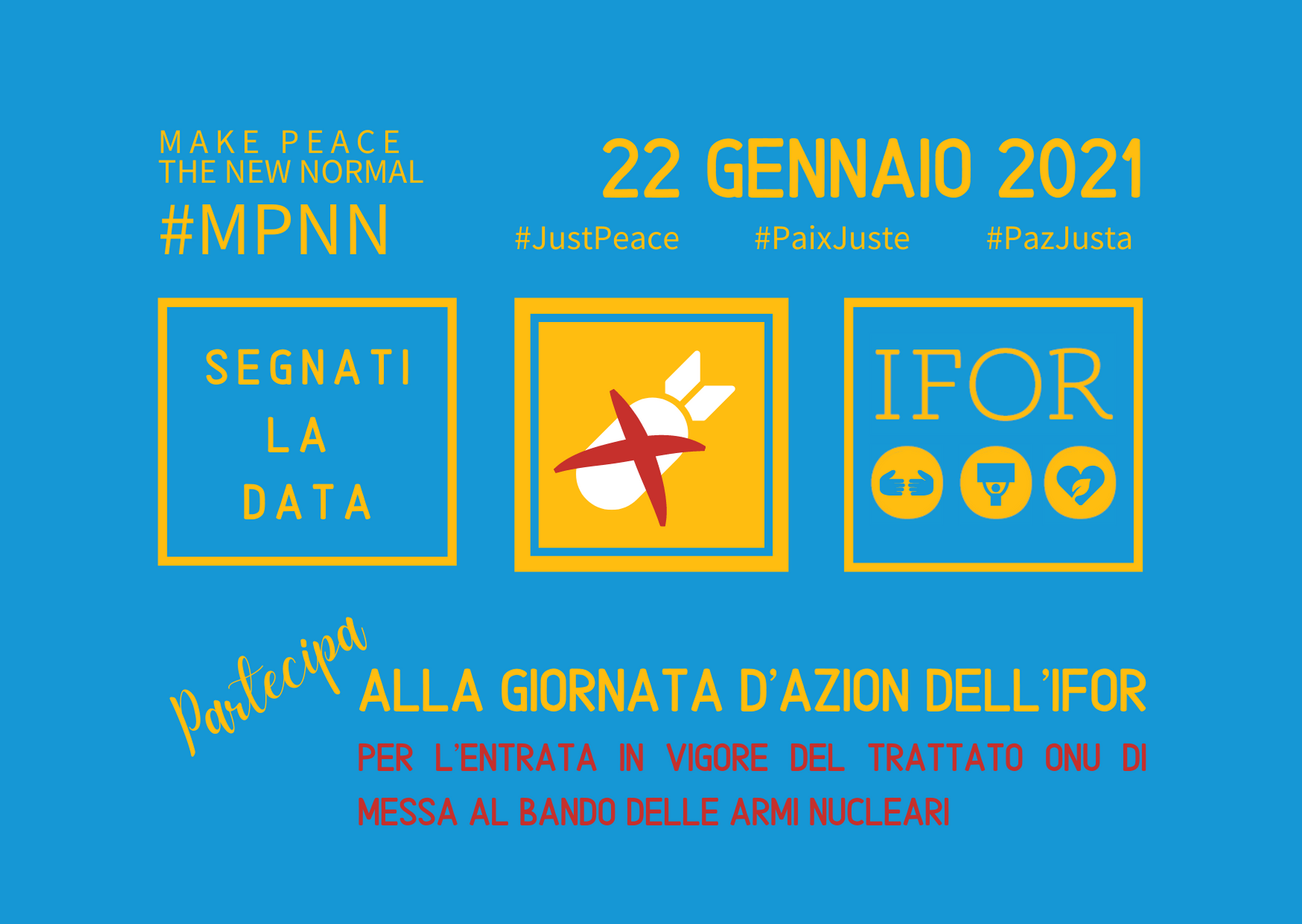
CELEBRATE THE NUCLEAR BAN and continue to MAKE PEACE THE NEW NORMAL

Get active on January 22nd 2021 – everywhere!

“Es la hora de CELEBRAR LA PROHIBICIÓN NUCLEAR y seguir HACIENDO DE LA PAZ LA NUEVA NORMALIDAD” haz aquí para ver la versión en español

“Célébrer l'INTERDICTION DES ARMES NUCLEAIRESet continuer à FAIRE LA PAIX DU NOUVEAU NORMAL” cliquez ici.

Check out the facebook event here!!!

After the first call which launched #MPNN and highlighted the need for #compassion, #accountability and #change, we are now to call everyone to action for nuclear disarmament, to contribute to peace and justice, thus to #JustPeace.

On January 22nd we join worldwide celebrations for the entering into force of the UN nuclear ban Treaty which states that nuclear weapons, not only are immoral, but also unlawful according to international law.


We now invite everyone to join a new IFOR Global Day of Action on January 22nd 2021


About the Day of Action

The new Day of Action will celebrate the entering into force of the UN nuclear ban Treaty adopted on July 7th 2017 by the UN General Assembly. It reached its 50th ratification on October 24th 2020, International UN Day. Through actions big and small, we aim to raise awareness about nuclear disarmament and the many issues linked to it such as nuclear investment, nuclear waste, nuclear tests, production, nuclear weapons stationing, nuclear pending threat, humanitarian risks and environmental risks and damages.

We invite everyone, everywhere, to RING A BELL FOR PEACE AT NOON! Click here to read more about it and download the pdf version!!

We will publish thematic posts and also display on Facebook a video message by IFOR president at 12 am CET, together with the video “If you love this planet” by ICAN.

Whether you are in lockdown, moving about and physically distancing, there are things you can do and plan to do in the near future during this year.

We invite everyone to engage at any or all of following levels:

§ COMMUNITY ACTION: Share solidarity to victims of environmental disasters due to nuclear resources exploitation, testing and waste.

§ SPIRITUAL ACTION: Provide a point of spiritual focus and reflection.

§ POLITICAL ACTION: Engage politicians, policy makers and public opinion leaders and authorities about the need for disarmament; thank those who ratified the Treaty and call on those who didn’t yet. Call on City and Regional Councils to pass resolutions supporting the TPNW.

Please decide on the types of activity you intend to carry out. A list of activities is available on the IFOR website to spark your imagination. Click here to read or download the list.

One common theme is the need to make people aware that we are taking action. On social media, we will connect our efforts by using the hashtag #MPNN and #JustPeace.


Ways to join the Day of Action

  • Take action on social media, share on Jan 22nd the SAVE THE DATE IMAGE, RING THE BELL or take different actions!!! also via Email with your networks. (Don’t forget to use the Hashtag #MPNN and #JustPeace and to tag IFOR (Fb @InternationalFellowshipofReconciliation) And don’t forget to act on the posting on IFOR Fb page and share them on your own pages.

  • Join the peace world at noon and RING A BELL FOR PEACE and record it by video or picture and share it on social media and make sure to send to IFOR Fb page or by email to iskra.ramirez@ifor.org  Click here for more details on this action.

  • Join IFOR president Lotta Sjöström Becker video message which will be broadcasted on IFOR’s Facebook page https://www.facebook.com/InternationalFellowshipofReconciliation at 12 pm CET after the screening of “If You Love This Planet“ video by ICAN (or watch the video afterwards!)

  • Support local initiatives regarding the entering into force of the UN Treaty and highlight issues such as 1. stop the money going into nuclear weapons, 2. end the political support and implement the Treaty, 3. environmental impact of nuclear weapons (production, testing, storage and use) and share the thematic graphics on social media, internet and by email. 

  • Implement these actions in your community! (Don’t forget to share with us what you are doing by posting it under #MPNN #JustPeace and tagging IFOR, or sending it to iskra.ramirez@ifor.org)


Highlight your initiatives

If you are doing something about nuclear disarmament and the entering into force of the UN Treaty, put it in the spotlight and make it known!

Post on social media! (Pictures, videos and short stories are all are great! Connect it to the larger movement by using the hashtag #MPNN and #JustPeace and tagging IFOR-International Fellowship of Reconciliation

Download our official graphics for the Day of Action available on IFOR website.

Send in your pictures, stories, and short descriptions of your projects to IFOR Communications Assistant iskra.ramirez@ifor.org and GET FEATURED on the IFOR Facebook Page!


Got Questions or Ideas?

Please contact us at iskra.ramirez@ifor.org for support with your ideas and images!

Comment

Comment

IFOR's last Newsletter for 2020, -Reconciled-

Dear IFOR Community,

A new year is upon us and while we look forward in hope of a better year, we can also reminisce about all the good work that was done during such a difficult year, as 2020 was.

Most of you may have already received our newsletter Reconciled.
It was sent out on the first week of December, however we decided to post it online as well, for all to be able to access.

From IFOR we wish you a happy and joyful 2021, and hope that this year unites us in the fight for non-violence and reconciliation.

You can download the newsletter by clicking here.
You can download the Spanish version by clicking here.
You can download the French version by clicking here.

Comment

IFOR speaks at the UN Human Rights Council on the right to conscientious objection in Ukraine

Comment

IFOR speaks at the UN Human Rights Council on the right to conscientious objection in Ukraine

download (1).png

On December 18th 2020, the International Fellowship of Reconciliation - IFOR participated in the UN Human Rights Council "Oral presentation of the report on the situation of human rights in Ukraine".

UN Assistant Secretary-General Ilze Brands Kehris, head of the UN Human Rights Office in New York, presented the UN report, followed by statements of member States and NGOs. At this link you can find the OHCHR reporting on Ukraine 

IFOR took the floor and expressed concern regarding the right to conscientious objection in Ukraine and referred to the case of the pacifist journalist, Ruslan Kotsaba, who has already spent 524 days in jail for an anti-war video posted in 2015 and titled "I refuse to mobilize". Here you can watch his video.

He is currently under trial, again, accused of treason and obstructing military operations.

Here you can read the full intervention made by the IFOR's main representative at the UN in Geneva, Zaira Zafarana.


Human Rights Council
Geneva, 18th December 2020
Interactive Dialogue on the oral presentation of the report on the situation of human rights in Ukraine.
Oral statement delivered by the International Fellowship of Reconciliation1

International Fellowship of Reconciliation - IFOR thanks the High Commissioner and her office for the report (on the situation of human rights in Ukraine) and expresses concern about the ongoing violations of the right to conscientious objection to military service.

Alternative service in Ukraine has a punitive and discriminatory character and it is hardly accessible. There are information from the ground about the current case of about 24 Pentecostals2 conscientious objectors who are unable to start alternative service because there is not an available employment3.

Another item of concern is Bill 35534, regarding military service and registration, adopted by the parliament in the first reading. It introduces new measures which forecast a negative impact on the rights and freedom of citizens.

IFOR would like, finally, to draw the attention of the Members of this Council and of the High Commissioner to the case of Ukrainian journalist and pacifist Ruslan Kotsaba who is again under trial5 because of a video posted in 2015 to express opposition to the military mobilization for armed conflict in eastern Ukraine6. He has already spent over 500 days under arrest for his expression of anti-war thoughts and is accused again of treason and obstructing military operations.

As already highlighted by IFOR7, “freedom of thought, conscience and religion is a non-derogable right”, alike freedom of expression, (“and it continues to apply regardless of a situation of armed conflict”).


1 According to the meeting participation rules, the statement has been delivered by video-message.
2 In Hoshcha Raion of Rivne Oblast.
3 Employment has to be suitable to the restrictive legal regulations of alternative service.
4 It has been proposed by President of Ukraine and is titled "On the amendments to several legislative acts of Ukraine concerning improvement in some aspects of conducting military service and military registration".
5 In Kolomyia City District Court of Ivano-Frankivsk Region. The High Specialized Court on Civil and Criminal Cases in 2017 quashed the acquittal and ordered a retrial. Then several judges and local courts recused from the case; the court ordered to return formal accusation for further investigation, but the order was quashed by the appellate court; and now, judges Kalyniuk, Berkeshuk, and Veselov will examine 58 witnesses of the supposed political impact of Ruslan's video blog and pass their judgment.
6 Ruslan Kotsaba was arrested on 7th February 2015 in Ivano-Frankivsk, 130 km south-east of Lviv, after he posted a video describing the conflict as “the Donbas fratricidal civil war”. He also expressed opposition to military conscription of Ukrainians to take part in the conflict. He was then named as Amnesty International’s first Ukrainian prisoner of conscience in five years. He has already spent 524 days under arrest and was duly acquitted in 2016. https://www.amnesty.org/en/latest/news/2015/04/ukraine-suspicious-deaths-need-credible-investigations/
7 Oral statements delivered by IFOR at the 45th session of the Human rights Council, on October 1st, during the ID with the High Commissioner on the findings of OHCHR report on the situation of human rights in Ukraine.

You can download this statement here. 


You can watch the registration of the above meeting of the UN Human rights Council here (IFOR intervention is at 1:07:29) 

Comment

IFOR STATEMENT ON THE U.S. RECOGNITION OF MOROCCAN SOVEREIGNTY OVER WESTERN SAHARA

Comment

IFOR STATEMENT ON THE U.S. RECOGNITION OF MOROCCAN SOVEREIGNTY OVER WESTERN SAHARA

On this day, December 14th 2020, which marks the 60th anniversary of the Declaration on the Granting of Independ-ence to Colonial Countries and Peoples, 1 IFOR is issuing a statement on the recent developments regarding the con-flict in Western Sahara.

STATEMENT ON THE U.S. RECOGNITION OF MOROCCAN SOVEREIGNTY OVER WESTERN SAHARA

The International Fellowship of Reconciliation (IFOR) was founded over 100 years ago, and at the heart of the fellowship is the steadfast belief in multilateralism as a way to engage within the international community.

On December 10th, President Donald Trump issued a proclamation stating that the United States will recognize Moroccan sovereignty over Western Sahara. 2 A departure from decades of U.S. policy, the move follows last month’s breakdown of the nearly 30-year ceasefire between Morocco and Western Sahara and the resumption of hostilities.

In 1991, the United Nations and the international community made a promise to the Saharawi people that a referendum would be organized, and that they freely and fairly would get to decide their own fate. 30 years later, that promise remains unfulfilled. Neither renewed fighting nor unilateral moves that disregard interna-tional law absolves the international community of this promise. On the contrary, it highlights the urgency of finally implementing the right to self-determination. Saharawi organizations have long sounded the alarm about the consequences of continued inaction and the eroding trust in the international community that fol-lows. 3

The initial reactions to the U.S. Administration’s announcement have been somewhat encouraging, with many countries denouncing the move. IFOR calls on all UN Member States to also act collectively in demonstrating their commitment to abide by international law and to be accountable for the implementation of funda-mental rights. In 2017, following the Trump administration’s announcement that the U.S. would recognize Je-rusalem as the capital of Israel – another example of unilateral action that disregarded international law– the UN General Assembly held an emergency special session and decisively backed a resolution that rejected the move. 4 Such action is again appropriate and necessary to reaffirm the primacy of international law.

With the current administration on its way out, it is also imperative that the new leadership in the U.S. act. IFOR urges President-Elect Biden to, immediately upon taking office, reverse the Trump administration’s de-cision and reaffirm the principles of international law, as the foundation for settling international conflicts, and multilateralism to strengthen international cooperation.

Further, IFOR calls once more for the UN Secretary-General António Guterres to immediately appoint a new UN Personal Envoy for Western Sahara 5. The vacancy at this position, and the continued wait of a credible path to a peaceful resolution, leaves the door open for the kind of negative developments seen in the last month.


1 General Assembly resolution 1514 (XV) of 14 December 1960. https://www.ohchr.org/EN/ProfessionalInterest/Pages/Independence.aspx

2 https://www.whitehouse.gov/presidential-actions/proclamation-recognizing-sovereignty-kingdom-morocco-western-sahara/

3 Open Letter to the UN Secretary General on the 45th Anniversary of the Western Sahara Conflict, released on November 14th by NOVA, a local nonviolent Saharawi youth organization. 4 General Assembly resolution 11995 of 21 December 2017, adopted at the 10th Emergency Special Session.

5 IFOR Statement on the current situation in Western Sahara, released on November 13th 2020. http://www.ifor.org/news/2020/11/13/ifor-statement-on-the-current-situation-in-western-sahara

You can download the statement by clicking here.

Comment