Promotion and protection of human rights to peace and conscientious objection to military service in the context of Russian aggression against Ukraine
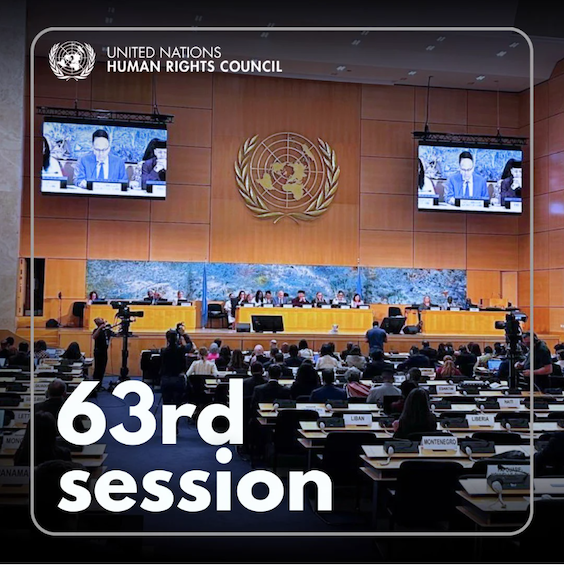
IFOR submitted the following written statement on Right to peace and conscientious objection to the 63rd session of the UN Human Rights Council under agenda item 10.
Human Rights Council solemnly stated in the Article 1 of the Declaration on the Right to Peace (A/HRC/RES/32/28) that everyone has the right to enjoy peace such that all human rights are promoted and protected and development is fully realized. The self-defense right under Article 51 of the UN Charter does not cancel obligation to seek peaceful conflict resolution according to Articles 2, 33 of the UN Charter. According to Articles 4, 18 of ICCPR and Human Rights Committee jurisprudence, right to conscientious objection is non-derogable in time of emergencies including wars, and conscientious objectors should be exempted from military duty or it must me substituted by civilian service to society compatible with the objector's religion or belief.
Right to peace, therefore, should be protected and promoted linking human right to conscientious objection with profound transformation of current system of militarized security arrangements, ending wrong tendencies of investing into war hundredfolds comparing to peace, build-up of military strategies and alliances while neglecting committments to peace and human rights under the UN Charter, depriving the United Nations of support and resources needed for making peace in peaceful ways.
We believe that current system of militarized security and compulsory military duty, where it exists, should be gradually replaced with institutions of nonmilitary peace protection, respecting the absolute right to refuse to kill and exploring nonviolent, nonmilitary action for protection of peace at inter/trans/national levels with participation of conscientious objectors, even in time of war, making national defense and international peacemaking strategies inclusive for pacifists.
In the first days of internationally condemned full-scale Russian invasion of Ukraine 24 February 2022, many people protested against the war of aggression in Russia and Belarus, while in Ukraine unarmed civilians heroically stopped tanks and made them turn away. Civil society demonstrated capacity and readiness to resist war nonviolently. However, this tendency did not prevailed because of the lack of institutional arrangements.
Instead, the continuation of the war has triggered widespread militarization across the region, severely undermining human rights. UN General Assembly Resolutions ES-11/1 and ES-11/6 explicitly condemned the Russian aggression, demanded full military withdrawal, and reaffirmed the imperative under Articles 2 and 33 of the UN Charter to resolve international disputes by peaceful means. Nevertheless, militaristic approaches continue to eclipse human rights guarantees.
The right to conscientious objection to military service is an inherent part of the right to freedom of thought, conscience, and religion under Article 18 of the International Covenant on Civil and Political Rights (ICCPR).
Under Articles 4 and 18 of the ICCPR, the right to freedom of thought, conscience, and religion is non-derogable, meaning it cannot be suspended even during times of war or public emergency threatening the life of the nation.
OHCHR analytical reports A/HRC/50/43, A/HRC/56/30, and A/HRC/62/24 consistently affirm that states must provide accessible, non-punitive, and non-discriminatory alternative civilian service to all individuals affected by military duties before, during, and after recruitment.
Freedom to have conscientious objection, serious and deeply held pacifist religion or belief, should not be impaired by forcible military registration, training, and service contrary to Article 18(2) of the ICCPR.
As highlighted by the UN Special Rapporteur on Russia (A/HRC/63/60) and reports of the UN Secretary-General, the Russian regime demands that men register for military service and subjects the population to constant threats of conscription or mobilization into the Russian armed forces. Russian antiwar activists, deserters, and conscientious objectors face severe repression, physical abuse, and prison sentences up to ten years in penal colonies. Russian forces also unlawfully compel residents of temporarily occupied territories of Ukraine into military service, in direct violation of Geneva Convention IV. (1)
Belarus continues to act as a co-belligerent by aiding Russian military operations while systematically persecuting domestic peace activists and conscientious objectors. Peace activists face arbitrary arrests, heavy fines, and long prison sentences under vague "extremism" laws, with all forms of antiwar speech or refusal of military registration strictly criminalized. (2)
While recognizing Ukraine's right to self-defense under UN Charter Article 51, self-defense does not override international human rights obligations or the right to conscientious objection.
The UN Independent International Commission of Inquiry on Ukraine (A/HRC/61/61) explicitly expressed concern over the complete absence of alternative civilian service during wartime, as well as instances of physical violence and forced transport of conscientious objectors to conscription centers and military units.
Ukraine failed to adopt law providing for alternative nonmilitary service in wartime, as was promised to the European Union, because Ukrainian army continues to deny conscientious objection as fundamental right believing that detentions and beating could force conscientious objectors into changing their religion or belief and turning into soldiers.
Human rights organizations, such as European Bureau for Conscientious Objection, have documented severe violations, including the violent death in military unit of a conscientious objector Dmytro Koval following his forced mobilization, as well as the ongoing persecution for conscientious objection, Quaker faith, peace and human rights activism of Yurii Sheliazhenko (3) who suffered arbitrary detention and torture in March 2026. (4)
Despite international human rights standards, European Union Member States have increasingly restricted access to humanitarian protection for refugees and conscientious objectors, including restrictions on Ukrainian refugees, Russian and Belarusian antiwar activists.
European countries face growing pressure and legislative debates regarding denying or restricting humanitarian protection and civil status extension for Ukrainian men of conscription age, coercing them back into a system lacking alternative civilian service options. The Implementing Decision (EU) 2026/1912 of 30 July 2026 was criticized by human rights defenders for its discriminatory character and risks for fundamental rights. (5)(6)
EU Member States continue to deny humanitarian visas, political asylum, and border entry to Russian and Belarusian conscientious objectors and deserters fleeing mobilization. By forcing individuals who refuse to participate in an illegal war of aggression back into hands of repressing regimes, the EU fails to meet its international obligations and contradicts efforts to weaken the aggressor's war machine. (7)(8)
Recommendations
We urge the Human Rights Council, its Special Procedures, and Member States to promote and protect right to peace, affirm the human right to conscientious objection to all forms of military duty, such as mandatory registration, training, and service, and take efforts for creation of national and international peace and security frameworks inclusive for pacifists, not marginalizing but expanding opportunities of conscientious objectors to contribute in nonmilitary ways into resilience and survival of nations and the humankind in time of emergencies. Creation of a mandate of a special rapporteur on conscientious objection and nonmilitary peace protection institutions on all levels is also advisable; such rapporteur could also be authorized to facilitate international networking of conscientious objectors advocating and implementing values and goals of the United Nations, sharing the best practices.
We urge Russia and Belarus to stop persecutions for antiwar speech and nonviolent action resisting militarism, to lift restrictions imposed on peace activists and organizations of conscientious objectors, also calling on Russia to end the war of aggression against Ukraine, withdraw from occupied territories of Ukraine, and use peaceful methods of conflict resolution with Ukraine.
We urge Ukraine to adopt a strategy of national self-defense from Russian aggression inclusive for pacifists, guarantee human right to conscientious objection to military service and all other forms of military duty, ensure that conscientious objectors are not forced for military registration, training and service, and could contribute to national resilience undergoing alternative nonmilitary service, training and registration for its purpose; end punishments, detention and ill-treatment for pacifist religion or belief, release prisoners of conscience.
We urge European Union to preserve high human rights standards facing security challenges related to Russian aggression, ensure right to peace by making preparations for nonmilitary responses to emergencies inclusive for pacifists, provide humanitarian protection and asylum to conscientious objectors from Russia, Belarus, and Ukraine, and ensure that Ukraine comply with accession committments related to introduction of alternative nonmilitary service in wartime.
Footnotes:
(1) https://ebco-beoc.org/russia/2025
(2) https://ebco-beoc.org/belarus/2025
(3) https://ebco-beoc.org/press-release/2026-07-04-ebco-calls-to-stop-torture-and-imprisonment-of-conscientious-objectors-in-ukraine
(4) https://www.quaker.org.uk/news-and-events/news/ukrainian-quaker-calls-for-human-rights-reforms-after-detention
(5) https://en.connection-ev.org/article-4771
(6) https://newsukraine.rbc.ua/interview/denying-protection-to-all-ukrainian-men-in-1782794875.html
(7) https://novayagazeta.eu/en/articles/2025/06/15/practice-what-you-preach-en
(8) https://ebco-beoc.org/press-release/2025-02-14-protection-of-russian-belarusian-conscientious-objectors-in-the-eu
The IFOR written statement on the UN website (downloadable pdf)