JOINT PUBLIC STATEMENT about Greek conscientious objector THOMAS KATSAROS

Comment

JOINT PUBLIC STATEMENT about Greek conscientious objector THOMAS KATSAROS

3 March 2023 Index: EUR 25/6508/2023

GREECE: GIVE THOMAS KATSAROS A FAIR EXAMINATION OF HIS GROUNDS FOR CONSCIENTIOUS OBJECTION UNDER AN AMENDED LEGISLATIVE FRAMEWORK IN LINE WITH INTERNATIONAL LAW AND STANDARDS

Ahead of the hearing on 6 March 2023, before the Council of State, Greece’s Supreme Administrative Court, of the case of Thomas Katsaros, whose application for the status of conscientious objector to military service has been rejected by the Minister of National Defence, Amnesty International, Connection e.V., the European Bureau for Conscientious Objection (EBCO), the International Fellowship of Reconciliation (IFOR) and War Resisters’ International (WRI) call on the Greek authorities to annul the decision of rejection and grant him a fair examination of his grounds for conscientious objection under an amended legislative framework in line with international and regional human rights law and standards and the recommendations of domestic human rights bodies.

Thomas Katsaros applied in May 2022 for conscientious objector status, requesting to instead perform the (punitive) alternative civilian service. His application was based on his ideological pacifist beliefs.

His application was rejected in August 2022 by the Minister of National Defence, after a recommendation by the special committee which has military participation, on the grounds that in their view from the submitted documentation “it is not inferred that the claimed conscientious grounds stem from a specific ideology, philosophical, religious or political”, preventing him from fulfilling his military duties in arms.

Thomas Katsaros submitted an appeal to the Minister of National Defence in September 2022.

However, due to the delay in receiving a response for such appeal, and the risk to miss the deadline for judicial appeal, in November 2022 he also submitted a judicial appeal to the Council of State, the Supreme Administrative Court. Throughout the years, there is a pattern of delay of response of the Minister of National Defence to appeals of rejected applicants, which entails for claimants of conscientious objection a risk of missing the deadline for judicial appeal.

Thomans Katsaros’s initial appeal was rejected by the same Minister of National Defence in January 2023, after a recommendation by a subsequent special committee which also has military participation in the panel.

The case of Thomas Katsaros illustrates two of the most problematic aspects of the legislation and practice concerning the right to conscientious objection in Greece: the lack of independence and impartiality of the procedures of examination of applications for conscientious objector status, and the discrimination faced by certain groups of conscientious objectors on the basis of the nature of their beliefs.

The expert organisations authoring this statement have analysed the case of Thomas Katsaros, against the applicable national law and practice on the basis of international law and standards and the recommendation of international and domestic bodies. They have found that the inadequate procedure of examination of applications for recognition of conscientious objectors is resulting in violations of his human rights including the right to freedom of thought, conscience and religion. Furthermore, the unequal treatment of conscientious objectors on the basis of the nature of their beliefs grounded on conscience may give rise to a violation of Thomas Katsaros’s right to equality before the law and equal protection under the law without any discrimination.

A. LEGISLATION AND PRACTICE IN GREECE

The final decision on applications for granting conscientious objector status is taken exclusively by one person, the Minister of National Defence, after a non-binding recommendation of a five-member Special Committee consisting of a military officer, three university professors and one member of the State's Legal Council acting as president. The members of the Committee are appointed by a Joint Decision of the Minister of National Defence, along with the Minister of Economy and Finance and the Minister of Education.

In practice, the Committee does not summon baptised Jehovah’s Witnesses having a certificate from their church, who are automatically granted conscientious objector status. This approach is the best practice according to OHCHR, the Human Rights Council and the only appropriate practice according to the European Parliament. However, the Committee does not apply this to all conscientious objectors and summons those citing other religious grounds or ideological (non-religious) grounds for their conscientious objection. This differentiation has been considered by the Greek Ombudsman as “a standard practice of unequal treatment”.

According to official figures, in 2021 the percentage of recognition by the Minister of National Defence of conscientious objectors invoking religious grounds was 99% while the percentage of recognition of conscientious objectors invoking ideological grounds was 0%. The considerable difference between the grounds to grant contentious objector status raises concerns over the state’s duty not to discriminate between conscientious objectors on the basis of the nature of their particular beliefs.

While a person whose application has been rejected has a right to appeal to the Minister of National Defence to change the decision, in practice, the appeal is examined by the same Committee, which recommends again to the Minister. Another possibility for appeal is to the Council of State, that is the Supreme Administrative Court.

B. PROCEDURES AND COMPOSITION OF THE BODY RESPONSIBLE FOR ASSESSING THE APPLICATIONS

International standards and recommendations of international bodies:

  • The Parliamentary Assembly of the Council of Europe, has set specific basic principles as for the procedure: Where the decision regarding the recognition of the right of conscientious objection is taken in the first instance by an administrative authority, the decision-taking body shall be entirely separate from the military authorities and its composition shall guarantee maximum independence and impartiality; the decision shall be subject to control by at least one other administrative body, composed likewise in the manner prescribed above, and subsequently to the control of at least one independent judicial body; it should be ensured that objections and judicial appeals have the effect of suspending the armed service call-up order until the decision regarding the claim has been rendered; applicants should be granted a hearing and should also be entitled to be represented and to call relevant witnesses.

  • The then UN Special Rapporteur on religious intolerance, since many years had set the relevant standards: “The decision concerning their status should be made, when possible, by an impartial tribunal set up for that purpose or by a regular civilian court, with the application of all the legal safeguards provided for in international human rights instruments. There should always be a right to appeal to an independent, civilian judicial body. The decision-making body should be entirely separate from the military authorities and the conscientious objector should be granted a hearing, and be entitled to legal representation and to call relevant witnesses.” The same standards continue to be cited by the UN Special Rapporteur on freedom of religion or belief as named now and the Office of the United Nations High Commissioner for Human Rights (OHCHR).

  • The OHCHR has determined that “Independent and impartial decision-making bodies should determine whether a conscientious objection to military service is genuinely held in a specific case. Such bodies should be placed under the full control of civilian authorities”. In the same report, the OHCHR has set up several minimum criteria so that application procedures are in line with international human rights norms and standards. The OHCHR has also cited acceptance of applications without inquiry as a best practice.

  • Already since 1998, the then UN Commission on Human Rights has welcomed the fact that some States accept claims of conscientious objection as valid without inquiry. The same has been repeated by its successor, the UN Human Rights Council.

  • The European Parliament has repeatedly pointed out that “no court or commission can penetrate the conscience of an individual” and has favoured the position that a declaration setting out the grounds should suffice for somebody to be recognized as a conscientious objector.

Recommendations of international and Greek bodies specifically to Greece

Greece has received numerous recommendations, even after the amendment of the legislation in 2019, which reduced the number of military officers in the special committee from two to one.

  • The European Court of Human Rights, in the Papavasilakis’ case, condemned Greece for violation of Article 9 of the European Convention of Human Rights (concerning the freedom of thought, conscience and religion). The Court stressed that the independence of the members of the competent body constitutes one of the fundamental conditions for the effectiveness of the examination of a case of a conscientious objector. The Court highlighted that the special committee had examined the case of the claimant in the presence of three – out of a total of five – members, with two of them being military officers, which resulted in the military being the majority. It has also pointed out that in this case, the fact that the final decision has been taken by the Minister of National Defence does not afford the requisite guarantees of impartiality and independence.

  • The UN Human Rights Committee in 2005 had expressed its concern for the fact that the examination of applications was solely under the control of the Ministry of Defence, and had recommended Greece to consider placing the assessment of applications for conscientious objector status under the control of civilian authorities. The Committee, indirectly but clearly, found that the Ministry of National Defence is not a civilian authority, and has expressed similar positions in the case of Russia too. Ten years later, it expressed its concerns, about, among other things, “the composition of the Special Committee and its reported lack of independence and impartiality”, and recommended Greece to “consider placing the assessment of applications for conscientious objector status under the full control of civilian authorities”. Furthermore, in its recent views on the Petromelidis v. Greece case, the Committee has reiterated that Greece “should review its legislation with a view to ensuring the effective guarantee of the right to conscientious objection under article 18 (1) of the Covenant”.

  • The Commissioner for Human Rights of the Council of Europe has explicitly recommended to Greece the “transfer of administrative responsibilities as regards granting conscientious objector status from the Ministry of Defence to an independent civilian department”.

  • The UN Special Rapporteur on freedom of religion or belief, since 2006, has adopted and stressed the recommendations of the UN Human Rights Committee to Greece, to consider placing the assessment of applications for conscientious objector status under the control of civilian authorities. In 2016, the UN Special Rapporteur highlighted the case of a rejected applicant, asked for him to be examined by an independent and impartial body, repeated the recommendations of the Human Rights Committee and urged the Greek authorities “that all necessary interim measures be taken to halt the alleged violations and prevent their re-occurrence and in the event that the investigations support or suggest the allegations to be correct, to ensure the accountability of any person(s) responsible for the alleged violations”. In July 2019, after the amendment of the legislation which reduced the number of military members in the special committee, the UN Special Rapporteur referred to the “the recently adopted law (4609/2019), which regrettably fails to recognize the status of conscientious objectors (COs) to military service in accordance with international human rights standards”. The Rapporteur also noted that “The assessment procedure remains unchanged”, and referred to the recommendations of the Human Rights Committee, pointing out that “the assessment of applications for conscientious objector status should be within the jurisdiction of civilian authorities”.

  • The UN Office of the High Commissioner for Human Rights (OHCHR) in 2017 has highlighted the concerns and recommendations of the Human Rights Committee, and the ECtHR judgement. In 2019, the OHCHR has explicitly stated about the bill (law 4609/2019) that it “remains problematic, given that, despite the new composition of the five-membered special committee with the inclusion of only one military officer (rather than of two), the assessment of applications for conscientious objections status is still not under the full control of civilian authorities”.

  • The Greek Ombudsman has stated: “The personal interview as a mean to ascertain reasons of conscience is controversial per se, insofar it submits an internal esprit to an examination of sincerity”.

  • The Greek National Commission for Human Rights has repeatedly recommended: “The competent authority deciding whether a person should be assigned to an alternative service or not, must be independent and should not include members of the military administration”. In 2019, commenting on the bill (now law 4609/2019), the GNCHR, explicitly stated that despite the reduction of the military officers the bill does not fully comply with the recommendations of monitoring bodies such as the Human Rights Committee, the UN Special Rapporteur on freedom of religion or belief and the Commissioner for Human Rights of the Council of Europe. In 2021, in its submission for the 3rd Cycle of UPR, the GNCHR has reiterated that “The assessment of applications for conscientious objector status is still not placed under the full control of civilian authorities”.

Breaches:

The expert organizations authoring this statement conclude that because of the inadequate procedure of examination of applications for recognition of conscientious objectors, there is a violation of the right to freedom of thought, conscience, religion and belief, as set out in Article 18 of the ICCPR, as well as Article 9 of the ECHR.

The current legislation on the examination of applications for alternative service continues to be in contravention of the recommendations of the UN Human Rights Committee by not requiring the new Special Committee to be wholly civilian and ensuring that the decision of granting conscientious objector status is not made by the Minister of Defence.


C. DISCRIMINATION BASED ON DIFFERENT GROUNDS OF OBJECTION

International standards and recommendations of international bodies:

  • The OHCHR has compiled the minimum criteria in order for the procedures for conscientious objector status to be in line with international human rights law and standards. Among them, there is the requirement for: “Non- discrimination on the basis of the grounds for conscientious objection and between groups. Alternative service arrangements should be accessible to all conscientious objectors without discrimination as to the nature of their religious or non-religious beliefs; there should be no discrimination between groups of conscientious objectors.”

  • The Human Rights Committee, in its General Comment 22, has stated that “there shall be no differentiation among conscientious objectors on the basis of the nature of their particular beliefs”. Subsequently, the Committee, in the context of its concluding observations, has consistently advocated for recognition of “the right to conscientious objection to military service without discrimination as to the nature of the beliefs (religious or non-religious beliefs grounded in conscience) justifying the objection”,39 or “without limitation on the category of conscientiously held beliefs”, and has expressed concerns “about the limiting of conscientious objection to military service only to members of registered religious organizations whose teaching prohibits the use of arms”.

  • The Human Rights Council has reminded states of “the requirement not to discriminate between conscientious objectors on the basis of the nature of their particular beliefs”.

Recommendations of international and Greek human rights bodies specifically to Greece

  • The Human Rights Committee, specifically in the case of Greece, has expressed concerns about “reports indicating discrimination on the basis of different grounds of objection to service” and has recommended that the alternative service should be “accessible to all conscientious objectors”. The Committee has recently referred to its previous concluding observations in the “List of issues prior to submission of the third periodic report of Greece” and asked Greece to “report on the measures taken to provide all conscientious objectors with an alternative to military service” (emphasis added). 

  • In the context of the Second Cycle of Human Rights Council’s Universal Periodic Review (UPR), Greece received a recommendation asking inter alia for the alternative service to be “accessible to all conscientious objectors”. Greece did not accept the recommendation. In the context of the Third Cycle of Human Rights Council’s Universal Periodic Review (UPR), Greece received a similar recommendation asking inter alia for “an alternative service to military service to which all conscientious objectors have access to”. Greece accepted the recommendation this time, which is yet to be implemented.

  • The OHCHR has highlighted both the Human Rights Committee’s concerns as well those of the Greek Ombudsman (see below) and the fact that Greece has rejected the recommendations about conscientious objectors in the context of UPR.

  • In 2016, the UN Special Rapporteur on freedom of religion or belief, referred to information received that the special committee “repeatedly rejects applicants who do not belong to the Jehova[h]’s Witnesses denomination”. In 2019, the UN Special Rapporteur referred to the concerns of the Human Rights Committee, stating that the recognition of the status of conscientious objector should not be executed in a discriminatory manner based on different application grounds.

  • The Greek Ombudsman has referred to “a continuous practice of unequal treatment: while for the so called “religious” objectors the committee is satisfied by the submission of the certificate of the relevant religious community and do not even summon them to an interview, the so called “ideological” objectors are often required to answer to questions concerning sensitive personal data, as for example the affiliation to a specific political tendency (cases 165151, 167596, 168243/2013).”

Breaches:

The expert organizations authoring this statement conclude that unequal treatment of conscientious objectors on the basis of the nature of their beliefs is a form of discrimination that constitutes a violation of Article 26 of the ICCPR, that entitles all persons to equality before the law and equal protection of the law without any discrimination.


D. RECOMMENDATIONS


Amnesty International, Connection e.V, the European Bureau for Conscientious Objection, the International Fellowship of Reconciliation and War Resisters’ International make the following recommendations to the Greek authorities:

  • Annul the ministerial decision of rejection of the application of Thomas Katsaros and other similar cases of conscientious objectors claiming their rights and grant them a right to a fair examination of their grounds for conscientious objection protected and upheld under an amended legislative framework in line with international and regional human rights law and standards and the recommendations of domestic human rights bodies.

  • Transfer the procedure of examination of applications for conscientious objector status under the full control of civilian authorities (i.e. to be transferred entirely away from the Ministry of National Defence) by a panel with a wholly civilian composition. The procedure should be conducted without delay and in a way that guarantees maximum independence and impartiality.

  • Accept claims of conscientious objection as valid without inquiry, in accordance with the best practice set out by UN and regional bodies.

  • Take immediate action in addition to the above to ensure compliance with the requirement not to discriminate between conscientious objectors on the basis of the nature of their particular beliefs.

Click here to download the statement

Comment

IFOR joins statement on the Right to Development at the 52nd session of the UN Human Rights Council

Comment

IFOR joins statement on the Right to Development at the 52nd session of the UN Human Rights Council

On monday February 27th the Human Rights Council started its 52nd session in Geneva. General Secretary Antonio Guterrez opened the high level segment of the session.

On February 28th an high level panel discussion on the Right to Development took place and IFOR joined a statement delivered by Associazione Papa Giovani XXIII.


Check against delivery

Mr. President,

The Declaration on the Right to Development provides an essential guide to the manner

in which States, the international community and all organs of society shall act and

cooperate to ensure an enabling environment for development that is sustainable, just,

equitable and inclusive.

Nowadays, inequality has worsened to the point of becoming a threat to our societies

undermining progress in the fight against poverty and endangering the future of our

planet. Crisis after crisis the long-term structural gaps have widened and consolidated.

The implementation of the right to development and the embrace of the principle of

international solidarity are of paramount importance and inescapable ways to reduce the

many inequalities that threaten fundamental human rights, in particular for those who

are marginalised and poor.

APG23 and the co-signing NGOs look forward to the prompt finalisation and adoption

of a convention on the right to development, convinced that this will be a further

important step for the implementation of such a vital right.

We regret that some States are still reluctant to fully recognise the right to development

in all its dimensions and/or promote its realization.

Once and for all, the time has come to free the right to development from the trap of the

political games as well as the tendency to cherry-pick its contents and let it fly!

Thank You!

Click here to download the statement.

Comment

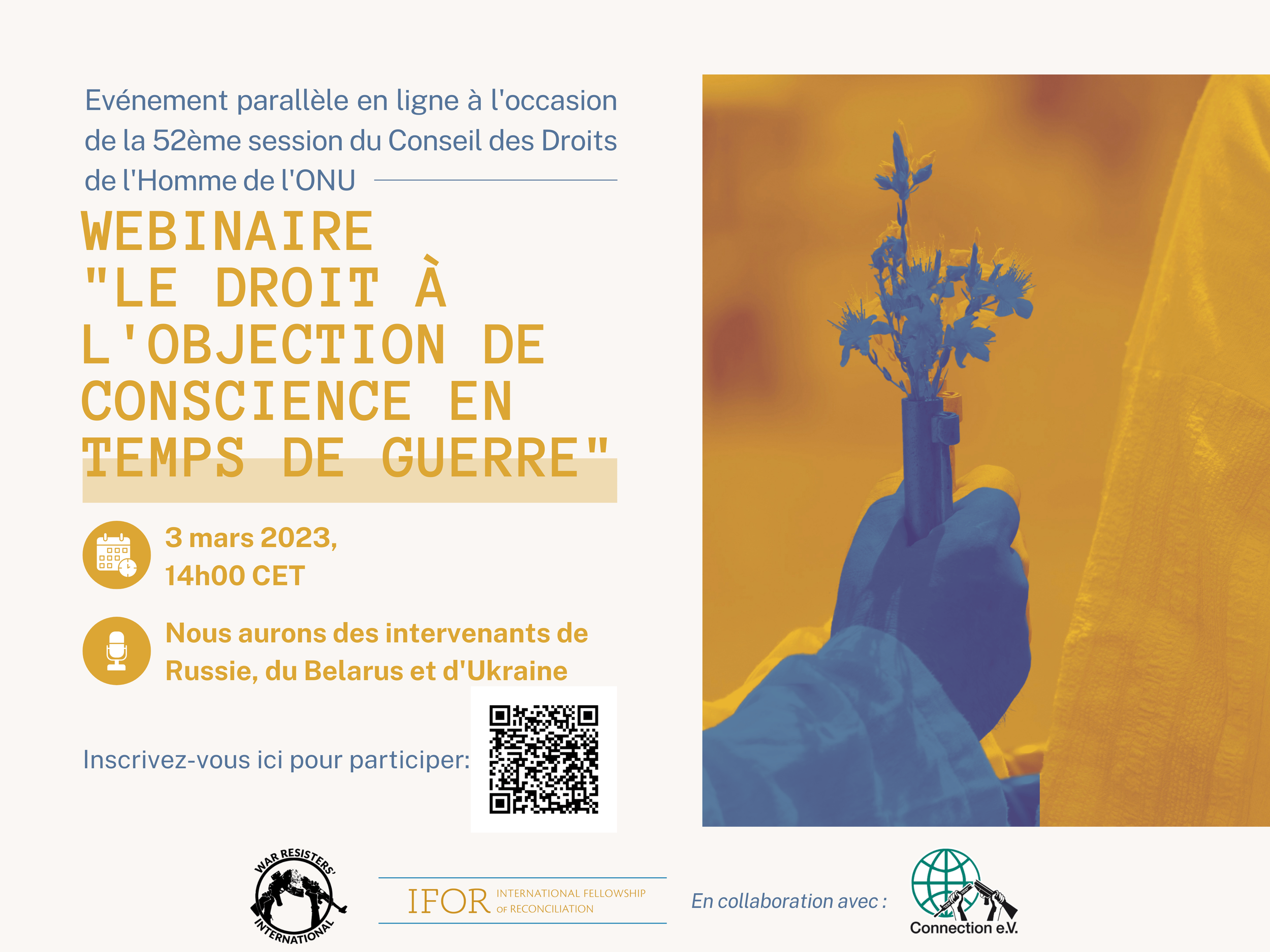
Webinar #2 "Conscientious Objection in times of War: Russia, Belarus and Ukraine"

Comment

Webinar #2 "Conscientious Objection in times of War: Russia, Belarus and Ukraine"

The webinar series launched last month on “Conscientious objection to military service in times of war” continues with a new session focusing on the war in Ukraine.


Webinar #2 will take place on March 3rd  at 2pm Geneva/ 3pm Kyiv / 4pm Moscow time and will host campaigners on conscientious objection from Russia, Belarus and Ukraine.

Interpretation will be provided in English, Spanish, French, Russian.

How can we support conscientious objectors and deserters from Russia, Belarus and Ukraine?
The war in Ukraine has raged for a year now, and there is little hope that it will end soon. The death toll and the destruction rise daily. Russia is unwilling to end its attack and withdraw, and is pumping more and more troops into Ukraine. There is an ongoing risk of Belarus’ active involvement in the war. Meanwhile, the Western countries support Ukraine in its defence by continuing to send more and more heavy weapons. Calls for negotiations and cease-fires remain unheard.
Conscientious objectors refusing to take part in this war is our hope for peace. Since the beginning of the war, we have witnessed hundreds of thousands of people on all sides fleeing their countries and refusing to participate in this war.
#ObjectWarCampaign

Our support for conscientious objectors and deserters is vital for peace!
On March 3rd, we will hear from campaigners for peace from Russia, Belarus and Ukraine about the situation of conscientious objectors in their countries and how we can support them.

Speakers
In this webinar, we will hear from
Elena Popovka (Movement of Conscientious Objectors, Russia)
Olga Karatch (Our House, Belarus)
Yurii Sheliazhenko (Ukrainian Pacifist Movement, Ukraine)

Registration
This event is free however registration is required.
Please use the link here to register.

This is an event organised by International Fellowship of Reconciliation and War Resisters’ International in collaboration with Connection e.V. and is taking place on the occasion of the 52nd session of the UN Human Rights Council in Geneva.

Pass along the word
Read more about our previous Webinar #1 here.


We are looking forward to meeting you on March 3rd!

Comment

International organizations call for action against forced mobilization and to support conscientious objectors and deserters in Russia and Ukraine

Comment

International organizations call for action against forced mobilization and to support conscientious objectors and deserters in Russia and Ukraine

22 February 2023

In the framework of the #ObjectWarCampaign (Russia, Belarus, Ukraine: Protection and asylum for deserters and conscientious objectors to military service), the International Fellowship of Reconciliation (IFOR), War Resisters’ International (WRI), the European Bureau for Conscientious Objection (EBCO), and Connection e.V. (Germany), call for actions at the Ukrainian and Russian embassies from the 23rd to the 27th of February 2023 to protest against the forced mobilisation and to express solidarity with Ukrainian and Russian conscientious objectors and deserters.

The four organisations denounce all the cases of forced and even violent recruitment to the armies of both sides, as well as all the cases of persecution of conscientious objectors and deserters.

The organisations highlight the case of 46-year-old Christian conscientious objector Vitaly Alekseenko who was convicted to one-year imprisonment sentence by the Ivano-Frankivsk Appeal Court on 16 January 2023 for refusing call up to the military on conscientious grounds. "I told the court I agree that I have broken the law of Ukraine," Alekseenko told Forum 18, "but I am not guilty under the law of God." Ivano-Frankivsk police told him "to be ready to be taken to prison" on 20 February 2023.

The four organisations consider the conviction of conscientious objector Vitaly Alekseenko a blatant violation of his right to freedom of thought, conscience and religion, guaranteed under Article 18 of the International Covenant on Civil and Political Rights, which is non-derogable in time of public emergency, according to Article 4.2 of ICCPR.

The organisations express their full solidarity with Vitaly Alekseenko and urge the Ukrainian authorities to drop all charges against him immediately. The organisations underline that his conviction occurs in the context that Ukraine has suspended the right of conscientious objection in the current emergency and call for the relevant decree to be immediately reversed.

The organisations also recall their strong condemnation of the Russian invasion of the Ukraine, and call on the soldiers not to participate in hostilities and on all recruits to refuse military service. They also demand Russia to stop prosecuting and release all anti-war protestors who non-violently oppose their government's war of aggression against Ukraine. The organisations as well as call on the Belarusian government to restrain from participation in and complicity with this war.

The Ukrainian, Russian and Belarusian governments should safeguard the right to conscientious objection to military service, including in wartime, fully complying with the European and international standards, amongst others the standards set by the European Court of Human Rights. Moreover, Ukraine is member of the Council of Europe and needs to continue to respect the European Convention of Human Rights. As now Ukraine becomes candidate to join the European Union, it will need to respect the Human Rights as defined in the EU Treaty, and the jurisprudence of the EU Court of Justice, which include the right of conscientious objection to military service.

Furthermore, the organisations emphasize that thousands of men and women on all sides are trying to flee their countries to evade the crimes of war. They are all our hope for overcoming violence. Therefore, the European Union should grant protection and asylum to all deserters and conscientious objectors! The Union should urge the Ukrainian government to stop persecuting conscientious objectors to military service and to guarantee them a full right to conscientious objection! And the European Union should open the borders to those who oppose war at great personal risk in their country!

Click here to download the press release


Contact persons:

The European Bureau for Conscientious Objection (EBCO) was founded in Brussels in 1979 as an umbrella structure for national associations of conscientious objectors in the European countries to promote the right to conscientious objection to preparations for, and participation in, war and any other type of military activity as a fundamental human right. EBCO enjoys participatory status with the Council of Europe since 1998 and is a member of its Conference of International Non-Governmental Organisations since 2005. EBCO is entitled to lodge collective complaints concerning the European Social Charter of the Council of Europe since 2021. EBCO provides expertise and legal opinions on behalf of the Directorate General of Human Rights and Legal Affairs of the Council of Europe. EBCO is involved in drawing up the annual report of the Committee on Civil Liberties, Justice and Home Affairs of the European Parliament on the application by the Member States of its resolutions on conscientious objection and civilian service, as determined in the “Bandrés Molet & Bindi Resolution” of 1994. EBCO is a full member of the European Youth Forum since 1995.


War Resisters' International (WRI) was founded in London in 1921 as a global network of grassroots organisations, groups and individuals working together for a world without war. WRI remains committed to its founding declaration that 'War is a crime against humanity. I am therefore determined not to support any kind of war, and to strive for the removal of all causes of war'. Today WRI is a global pacifist and antimilitarist network with over 90 affiliated groups in 40 countries. WRI facilitates mutual support, by linking people together through publications, events and actions, initiating nonviolent campaigns that actively involve local groups and individuals, supporting those who oppose war and who challenge its causes, and promoting and educating people about pacifism and nonviolence. WRI runs three programmes of work that are important to the network: The Right to Refuse to Kill Programme, the Nonviolence Programme, and Countering the Militarisation of Youth.


The International Fellowship of Reconciliation (IFOR) was founded in 1914 in response to the horrors of war in Europe, and has taken a consistent stance against war and its preparation throughout its history. Today IFOR has branches, groups, and affiliates in over 40 countries on all continents, while the International Secretariat is located in the Netherlands. IFOR’s membership includes adherents of all the major spiritual traditions as well as those who have other spiritual sources for their commitment to nonviolence. IFOR has observer and consultative status to the United Nations ECOSOC and UNESCO organisations. IFOR maintains permanent representatives in Geneva, New York and Vienna and at the UNESCO in Paris who regularly participate in conferences and meetings of UN bodies, providing testimony and expertise from different regional perspectives, promoting non-violent alternatives in the fields of human rights, development, and disarmament.


Connection e.V. was founded in 1993 as an association advocating a comprehensive right to conscientious objection at an international level. The organisation is based in Offenbach, Germany, and collaborates with groups opposing war, conscription and the military in Europe and beyond, extending to Turkey, Israel, the U.S., Latin America and Africa. Connection e.V. demands that conscientious objectors from war regions should get asylum, and offers counseling and information to refugees and support for their self-organisation.

Comment

CALL TO ACTION "No Means No – to the War in Ukraine"

Comment

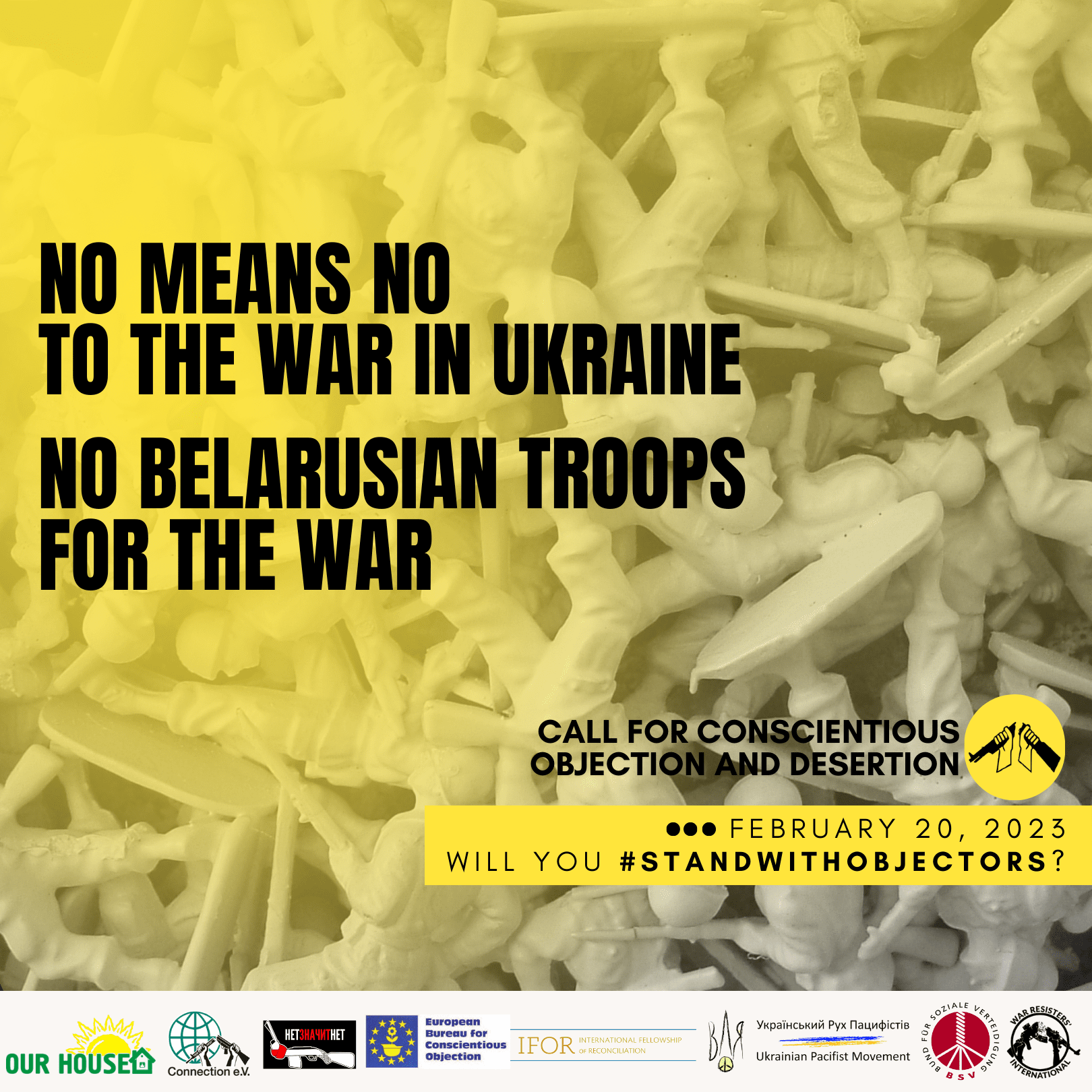
CALL TO ACTION "No Means No – to the War in Ukraine"

International Organizations Call For Actions at the Belarusian Embassies on the 20th of February to Protest Against a Possible Entry into the War in Ukraine by Belarus, and to Support Conscientious Objectors and Deserters.


No Means No – to the War in Ukraine

No Belarusian Troops for the War – Call for Conscientious Objection and Desertion

On the 20th of February 2023, we - Nash Dom, Ukrainian Pacifist Movement, Connection e.V., Federation for Social Defence, International Fellowship of Reconciliation, Agir pour la paix and War Resisters’ International – call for demonstrations outside Belarusian embassies across Europe. These protests will draw attention to the danger of Belarus joining Russia by sending military personnel to attack Ukraine.

The war in Ukraine has raged for almost a year now, and there is little hope that it will end soon. The death toll and the destruction rise daily. Russia is unwilling to end its attack and withdraw, and is pumping more and more troops into Ukraine. The Western countries support Ukraine in its defence by continuing to send more and more heavy weapons. Calls for negotiations and cease-fires remain unheard.

On the 20th of February 2022, Russian troops were ordered to stay in Belarus after the end of a joint exercise with the Belarusian army. Four days later, the attack against Ukraine began, including Russian troops based in the territory of Belarus. Up until now no Belarusian troops have joined the war, though Belarus provides logistical aid to Russia.

The right to refuse to kill is a human right, recognized by various international human rights institutions. In Belarus, this right is not recognized. Conscientious objectors and deserters are persecuted and jailed. This has meant that more than 20,000 young men have been left with no choice but to leave their homeland and seek refuge abroad, because they feared being recruited. Most of them prefer to stay close to their former home – in the Baltic countries and Poland – which puts a heavy burden on their host countries. These countries need support from their partners in the EU! Such a mass movement of objectors also sends a strong message to Russia. Belarus under Lukashenko so far has been the stoutest ally of Putin’s Russia. When its citizens refuse to join the war, this will hopefully further demoralize the nationalist and militarist narratives in Russia as well.

No means no! We call to:

  • support for Nash Dom’s “NO means NO” campaign. The campaign calls on men of Belarus to refuse to join the army or to leave it if they are already serving: Have the courage to say “No” when asked to join a war that violates international law and causes massive death, suffering and destruction in a neighbouring country! You are a hero if you object, not if you become a soldier in this war!

  • mothers, fathers, sisters and brothers in Belarus to encourage their boys not to join the military and to help them to escape from recruitment.

  • to the Belarusian authorities

    • to respect the human right of conscientious objection to military service and

    • to restrain from participation in and complicity with the war of aggression against Ukraine by the Russian authorities.

  • the governments of the European countries

    • to establish a humanitarian corridor for Belarusian conscientious objectors and deserters.

    • to give shelter to objectors and deserters from Belarus on humanitarian grounds, without forcing them into an asylum procedure.

  • the churches to use their influence and moral weight to protect those who refuse to fight.

  • civil society in all countries to express its support for objectors and deserters from all sides in the war. Support the #ObjectWarCampaign which is demanding shelter and asylum for objectors of the war in Ukraine.

  • the civil servants and diplomats of Belarus in the embassies where we will hold our protests to express solidarity with those who oppose the war.

For more information in your country, support of the appeal and information about action plans in your country, please write to: info@nash-dom.info

Read here the full text of the call with first signatories.

Join the action  'No means NO - to the War in Ukraine' on February 20th!


INSIGHTS

- “We are concerned that Lukashenko might plan to send the Belarusian army to fight on the side of Russia in the war”, Rudi Friedrich, the coordinator of the German organization ‘Connection e.V.’ says. “We want to send a strong signal in support of the Belarusian NGO Nash Dom’s campaign ‘NO means
NO’ which calls on men of Belarus to refuse to join the army or to leave it if they are already serving."
- “More than 20,000 young men have already left Belarus to avoid service in the army. Most of them are in the Baltic countries or in Poland, adding to the swelling numbers of refugees there. These countries urgently need financial and material aid by their partners in the EU to adequately cater to the needs of these refugees. And we need a humanitarian corridor for them”, explains Olga Karatch, the head of ‘Nash Dom’.
- “To us, the right to conscientious objection which has been established at the UN as a universal human right is essential. Those who do not wish to fight must not be punished or sent to prison as it is currently the case. We call on the Lukashenko regime in Belarus to respect the human right of conscientious objection to military service and to restrain from participation in and complicity with Putin’s regime war of aggression against Ukraine.” explains the Ukrainian Pacifist Movement.
- Dr. Christine Schweitzer, the Coordinator of the German NGO “Federation for Social Defence” expresses the hope that such a mass movement of objectors also sends a strong message to Russia. “Belarus under Lukashenko so far has been the stoutest ally of Putin’s Russia. When its citizens refuse to join the war, this will hopefully further demoralize the nationalist and militarist narratives in Russia as well, and increase the pressure to put an end to this war”, she says. “We also hope that other initiatives, for example those that have in the past supported the twinning between cities in Belarus and the West, use this occasion to make new contact with their partners in Belarus and encourage them to support those who do not want war.”

CONTACTS
Alexia Tsouni, European Bureau for Conscientious Objection (EBCO), ebco(at)ebco-beoc.orgwww.ebco-beoc.org (English, Greek)
Semih Sapmaz, War Resisters’ International (WRI), semih(at)wri-irg.org, www.wri-irg.org (English, Turkish)
Zaira Zafarana, International Fellowship of Reconciliation (IFOR), zaira.zafarana(at)ifor.orgwww.ifor.org (English, Italian)
Rudi Friedrich, Connection e.V., office@Connection-eV.org, www.Connection-eV.org (English, German)
Ukrainian Pacifist Movement: shelya.work@gmail.com (English, Ukrainian, Russian)
Olga Karatch, Nash Dom, olga.karatch@gmail.com (English, Belarusian, Russian)
Christine Schweitzer, Bund für Soziale Verteidigung, Christine Schweitzer, schweitzer@soziale-verteidigung.de (English, German)

Comment

IFOR at the Africa Regional Seminar on the TPNW in Pretoria

Comment

IFOR at the Africa Regional Seminar on the TPNW in Pretoria

The African Regional Seminar on the Universalisation of the TPNW was held in Pretoria, South Africa, on 30-31 January 2023, and it was preceded by a full day ICAN Campaigners Meeting. 
The Seminar has been co-hosted by South Africa’s Department of International Relations and Cooperation (DIRCO), ICAN, and the International Committee of the Red Cross. 37 African states sent their senior government officials from their capitals to participate, Mexico and Malaysia were also represented.

Read more here.


CAMPAIGNERS MEETING

29TH JANUARY 2023

  • This session for campaigners began by painting the picture of what we want to see in the world and the explaining what ICAN is and what it stands for.

  • This was followed by a session on the success stories of those campaigners whose countries have successfully signed and ratified the TPNW. Of note was the Comoros story.

  • The Campaigners meeting helped much in networking with like-minded peace campaigners in Africa.

BRIEF OUTLOOK

  • Zimbabwe has signed but not yet ratified.

  • Kenya highlighted that the influence of campaigners from other countries could help. 

  • Ethiopia is encountering some resistance.  

  • In Central African Republic. awareness and literacy on Nuclear Weapons is very low.

  • In Comoros, diplomacy and non-confrontational approach brought results. 


Key Areas Needing Attention Highlighted in the Campaigners Meeting. 

  1. Protocol challenges on whom to approach is hindering and delaying progress. 

  2. Lack of resources was sighted as another key challenge. 

  3. Great collaboration needed in supporting each other on social media growth and impact.

  4. Networking is key to both information dissemination and advocacy. 


AFRICA REGIONAL SEMINAR ON THE UNIVERSALISATION OF THE TPNW

30th January 2023

SESSION 1

  • The chair Mr Zaheer Laher of the Department of International Relations and Cooperation of South Africa acknowledged the critical role of African States in the drive to have states ratify the TPNW.  

  • Mr Alvin Botes the South African Deputy Minister of International Relations and Cooperation highlighted South Africa’s commitment to a nuclear free world and exhorted every participant to utilise the seminar opportunity.

  • Ms Beatrice Fihn, Executive Director of ICAN highlighted the urgency of the matter and commended the African States that have ratified.

  • Mr Jules Amoti, Head of ICRC brought to the fore the catastrophic consequences of nuclear weapons which must never be underestimated. It our duty he said to see to it that as many countries ratify the TPNW. This he said is just the beginning and not an end.

SESSION 2

  • Sarah Mabheza, Regional Legal Advisor of ICRC Pretoria highlighted the Human Consequences of Nuclear Weapons.

    The screening of video “Algeria - Point Zero the invisible Jerboa” brought to reality the consequences of nuclear weapons. 

  • Edwick  Madzimure spoke well on Transboundary effects of nuclear weapons use for Africa

SESSI0N 3

  • Relationship between the TPNW and the global and regional disarmament architecture was well articulated and Prof J Pretorius of the University of Western Cape painted a somewhat gloomy outlook as he encouraged more efforts and commitment towards the ratification of the TPNW. 

  • Christopher Kayoshe of AU Commission narrated the AU history of commitment and support to the TPNW showing a hopeful outlook and great serious intention on the part of AU.

  • SESSION 4

  • States represented had an opportunity to speak on the progress and commitment towards the TPNW and below are some of the key highlights. 

  • Zimbabwe has fully signed the treaty and fully supported it and was in the process of ratification. 

  • Guinea-Bissau acknowledged all the supporting partners to the seminar and mentioned that every state has its own peculiarity and each state should play its role.  

  • Nigeria indicated that it is fully behind the whole process, while Ghana was working towards ratifying. 

  • Cape Verde encouraged the majority of present states to ratify the treaty. 

  • Central African Republic said the country is on course.

31st January 2023

  • Mr Zahheer Laher showed that while Africa does not produce nuclear weapons it is however at the mercy of the producers.

  • Ambassador Syed Mohamad Aide the permanent representative of Malaysia to the United Nations spoke on the need for more commitment from the Africa States. Malaysia has ratified the TPNW. 

  • Mozambique is in full support of the initiative and aspires for a nuclear free world.

  • Equatorial Guinea registered disappointment on the refusal of global powers to sign the treaty.

  • Gambia said it is in full support of the TPNW. 

  • Sierra Leone said the timing is great. Sierra Leonne supported the humanitarian pledge from onset. It highlighted the negative impact of a nuclear weapon use and indicated its high level of commitment.

  • Zambia is still a signatory and is in the processes of ratifying.  Zambia expects to ratify the treaty by end of this year. 

  • Madagascar showed that the use and the risk of nuclear weapon usage is so high and is in solidarity with the drive towards the signing and ratification of the TPNW. 

  • Lesotho values the positive effect of the treaty and exhorted other states to support the universalisation of the treaty. Lesotho has both signed and ratified the treaty. 

  • Democratic Republic of Congo is fully cognizant and regrets that that the uranium used in Hiroshima and Nagasaki bombs was mined in DRC. It has since signed and ratified the treaty 

  • Dr Noel Stott of VERTIC highlighted that universalization takes an understanding that all parties have universal information. 


USEFUL MATERIALS


Have a look at IFOR participation in the Vienna nuclear ban week in June 2022 here.


Comment

Webinar #1 on the right to conscientious objection ot military service in times of war

Comment

Webinar #1 on the right to conscientious objection ot military service in times of war

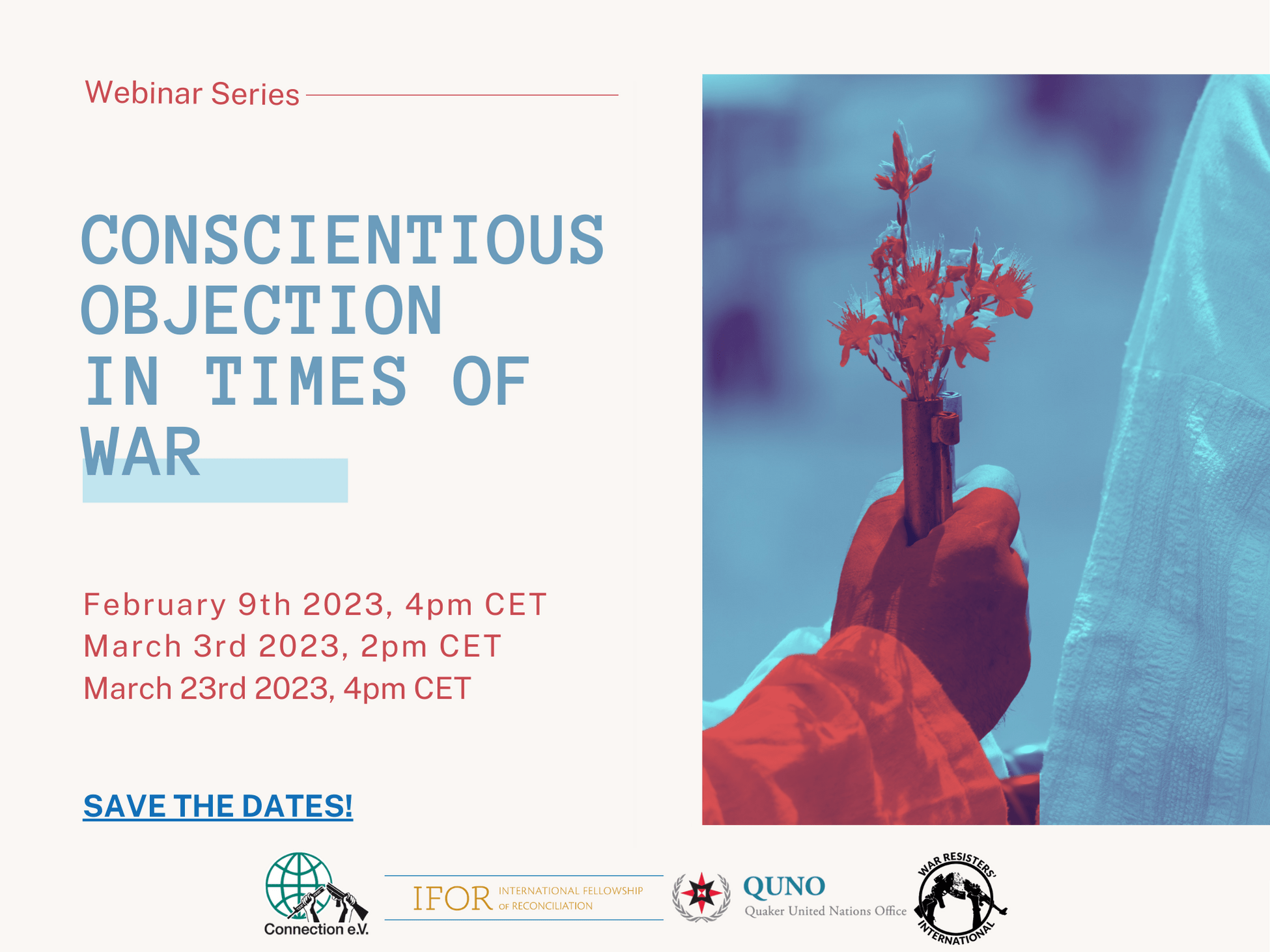
Webinar series: Conscientious objection in times of war

You’re invited to a new webinar series on “The right to conscientious objection to military service in times of war”.

Connection e.V., International Fellowship of Reconciliation (IFOR), Quaker United Nations Office (QUNO) and War Resisters’ International (WRI) are starting a webinar series focusing on conscientious objection to military service in times of war this February. 

The series will include a number of webinars each focusing on a particular conflict zone with the participation of conscientious objectors and campaigners on conscientious objection to military service.

Even if the war in Ukraine is in the foreground of the news coverage, war is being waged in many countries today. And in all these wars, there are people who evade recruitment, refuse military service or desert. Because of the threat of repression in their own countries, they seek protection abroad, which is unfortunately all too often denied them.

With this webinar series, we will hear from refusers and campaigners on conscientious objection from Colombia, Eritrea, Belarus, Ukraine, Russia, and elsewhere, and discuss the ways in which we can support them.

WEBINAR # 1

This first, introductory, webinar will take place on February 9th at 4pm CET.

Register here to get the link to participate.

Speakers

Our first webinar will give a general introduction to our series including short presentations on what international law says about conscientious objection in times of war, as well as the asylum rights of conscientious objectors from countries waging war. 

In addition, we will hear from campaigners from Colombia, Eritrea and Ukraine about their ongoing campaigns to support conscientious objectors. 

The speakers will include:

  • Rachel Brett (War Resisters’ International)

  • Helen Kidan (Eritrean Movement for Democracy and Human Rights)

  • Maricely Parada (Colombian Collective Action of Conscientious Objectors)

  • Yurii Sheliazhenko (Ukrainian Pacifist Movement) 

  • Rudi Friedrich (Connection e.V.)

Date and Time

9th February, Thursday, 4pm CET

Registration

This event is free, however registration is required. 

Please use the link here to register.

Share on social media as well.


We are looking forward to meeting you on February 9th!


Participate in webinar #2 on Russian, Belarus, Ukraine context, on March 3rd: register here and learn more here.

Comment

'Reconciled' IFOR newsletter, 2022 Edition

Comment

'Reconciled' IFOR newsletter, 2022 Edition

Dear IFOR community and friends,

We are delighted to send out the latest bulletin of 'Reconciled'! Please enjoy the news from around the Fellowship. This is a public edition and can be shared widely within your BGAs, membership and other friends who may be interested.

You will note that the date mark is October 2022. The final editorial process itself took a very long time, as we were dealing with some issues. We therefore decided to keep the date of October 2022. Any news from November onwards will be picked up in the next edition. Thanks for your understanding.

You can download the English PDF version of Reconciled 2022 here.


Chère communauté et amis du MIR,

Nous sommes ravis de vous envoyer le dernier bulletin de 'Réconcilié' ! Veuillez profiter des nouvelles de la communauté. Il s'agit d'une édition publique et peut être largement partagée au sein de vos BGA, de vos membres et d'autres amis susceptibles d'être intéressés.

Vous remarquerez que la date limite est octobre 2022. Le processus éditorial final lui-même a pris beaucoup de temps, car nous traitions de certains problèmes. Nous avons donc décidé de conserver la date d'octobre 2022. Toute nouvelle à partir de novembre sera reprise dans la prochaine édition. Merci pour votre compréhension.


Vous pouvez télécharger la version PDF française de Reconciled 2022 ici.


Estimada comunidad y amigos de IFOR,

¡Estamos encantados de enviar el último boletín de 'Reconciliados'! Por favor, disfrute de las noticias de toda la Fraternidad. Esta es una edición pública y se puede compartir ampliamente con sus BGA, miembros y otros amigos que puedan estar interesados.

Notará que la marca de fecha es octubre de 2022. El proceso editorial final en sí tomó mucho tiempo, ya que estábamos tratando con algunos problemas. Por lo tanto, decidimos mantener la fecha de octubre de 2022. Cualquier novedad a partir de noviembre se recogerá en la próxima edición. Gracias por su comprensión.

Puede descargar la versión en PDF en español de Reconciliad@s 2022 aquí.

Comment

Ukraine: Drop all charges against Vitaly Alekseenko immediately

Comment

Ukraine: Drop all charges against Vitaly Alekseenko immediately

The right to conscientious objection to military service is a human right inherent to the right to the freedom of conscience, thought and religion. It's a universal and non-derogable right.

Currently Ukraine has violated the right, suspending it and for the first known time since Russia invaded Ukraine in February 2022, Ukraine has jailed an individual for refusing on grounds of conscience a military call-up.


PRESS RELEASE:

Click here to download official release
The release is available in French here
The release is available in Italian here

Ukraine: Drop all charges against Vitaly Alekseenko immediately

18 January 2023

In Ukraine, on 16 January 2023, Ivano-Frankivsk Appeal Court rejected the appeal of 46-year-old Christian Vitaly Alekseenko against his conviction for refusing call up to the military on conscientious grounds. "I told the court I agree that I have broken the law of Ukraine," Alekseenko told Forum 18, "but I am not guilty under the law of God." When he gets the written verdict, which he expects on 19 January, the one-year imprisonment sentence will go into force and he expects to be taken to prison immediately afterwards.

The European Bureau for Conscientious Objection (EBCO), War Resisters’ International (WRI), the International Fellowship of Reconciliation (IFOR) and Connection e.V. (Germany) consider the conviction of conscientious objector Vitaly Alekseenko a blatant violation of his right to freedom of thought, conscience and religion, guaranteed under Article 18 of the International Covenant on Civil and Political Rights, which is non-derogable in time of public emergency, according to Article 4.2 of ICCPR.

The organisations express their full solidarity with Vitaly Alekseenko and urge the Ukrainian authorities to drop all charges against him immediately.

The organisations underline that his conviction occurs in the context that Ukraine has suspended the right of conscientious objection in the current emergency and call for the relevant decree to be immediately reversed.

The organisations also recall their strong condemnation of the Russian invasion of the Ukraine, and call on the soldiers not to participate in hostilities and on all recruits to refuse military service.

The Ukrainian government should safeguard the right to conscientious objection to military service, including in wartime, fully complying with the European and international standards, amongst others the standards set by the European Court of Human Rights. Ukraine is member of the Council of Europe and needs to continue to respect the European Convention of Human Rights. As now Ukraine becomes candidate to join the European Union, it will need to respect the Human Rights as defined in the EU Treaty, and the jurisprudence of the EU Court of Justice, which include the right of conscientious objection to military service.

More info: Forum 18

Photo: Vitaly Alekseenko, Copyright: Vitaly Alekseenko

#ObjectWarCampaign: Russia, Belarus, Ukraine: Protection and asylum for deserters and conscientious objectors to military service

Contact persons:

Alexia Tsouni, European Bureau for Conscientious Objection (EBCO), ebco@ebco-beoc.org, www.ebco-beoc.org (English, Greek)

Semih Sapmaz, War Resisters’ International (WRI), semih@wri-irg.org, www.wri-irg.org (English, Turkish)

Zaira Zafarana, International Fellowship of Reconciliation (IFOR), zaira.zafarana@ifor.org, www.ifor.org (English, Italian)

Rudi Friedrich, Connection e.V., office@Connection-eV.org, www.Connection-eV.org (English, German)


The European Bureau for Conscientious Objection (EBCO) was founded in Brussels in 1979 as an umbrella structure for national associations of conscientious objectors in the European countries to promote the right to conscientious objection to preparations for, and participation in, war and any other type of military activity as a fundamental human right. EBCO enjoys participatory status with the Council of Europe since 1998 and is a member of its Conference of International Non-Governmental Organisations since 2005. EBCO is entitled to lodge collective complaints concerning the European Social Charter of the Council of Europe since 2021. EBCO provides expertise and legal opinions on behalf of the Directorate General of Human Rights and Legal Affairs of the Council of Europe. EBCO is involved in drawing up the annual report of the Committee on Civil Liberties, Justice and Home Affairs of the European Parliament on the application by the Member States of its resolutions on conscientious objection and civilian service, as determined in the “Bandrés Molet & Bindi Resolution” of 1994. EBCO is a full member of the European Youth Forum since 1995.


War Resisters' International (WRI) was founded in London in 1921 as a global network of grassroots organisations, groups and individuals working together for a world without war. WRI remains committed to its founding declaration that 'War is a crime against humanity. I am therefore determined not to support any kind of war, and to strive for the removal of all causes of war'. Today WRI is a global pacifist and antimilitarist network with over 90 affiliated groups in 40 countries. WRI facilitates mutual support, by linking people together through publications, events and actions, initiating nonviolent campaigns that actively involve local groups and individuals, supporting those who oppose war and who challenge its causes, and promoting and educating people about pacifism and nonviolence. WRI runs three programmes of work that are important to the network: The Right to Refuse to Kill Programme, the Nonviolence Programme, and Countering the Militarisation of Youth.

The International Fellowship of Reconciliation (IFOR) was founded in 1914 in response to the horrors of war in Europe, and has taken a consistent stance against war and its preparation throughout its history. Today IFOR has branches, groups, and affiliates in over 40 countries on all continents, while the International Secretariat is located in the Netherlands. IFOR’s membership includes adherents of all the major spiritual traditions as well as those who have other spiritual sources for their commitment to nonviolence. IFOR has observer and consultative status to the United Nations ECOSOC and UNESCO organizations. IFOR maintains permanent representatives in Geneva, New York and Vienna and at the UNESCO in Paris who regularly participate in conferences and meetings of UN bodies, providing testimony and expertise from different regional perspectives, promoting non-violent alternatives in the fields of human rights, development, and disarmament.


Connection e.V. was founded in 1993 as an association advocating a comprehensive right to conscientious objection at an international level. The organisation is based in Offenbach, Germany, and collaborates with groups opposing war, conscription and the military in Europe and beyond, extending to Turkey, Israel, the U.S., Latin America and Africa. Connection e.V. demands that conscientious objectors from war regions should get asylum, and offers counseling and information to refugees and support for their self-organization.

Comment

IFOR Juba Council: statement on Colonialism and Africa

Comment

IFOR Juba Council: statement on Colonialism and Africa

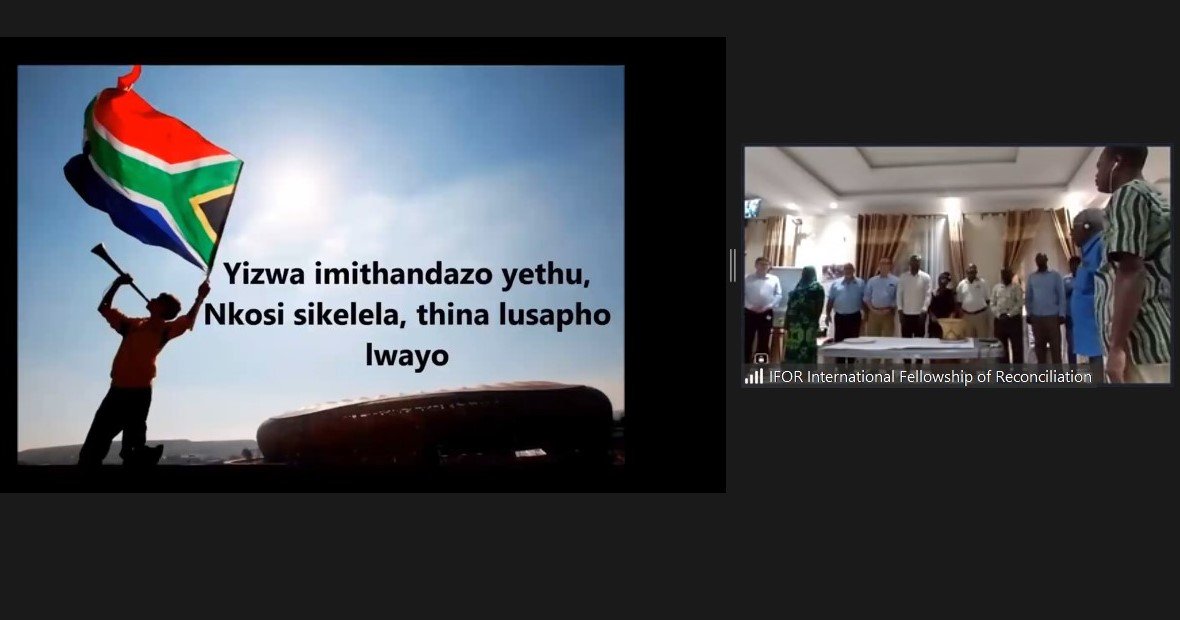
The International Fellowship of Reconciliation gathered in Juba, South Sudan, for its quadrennial Council on November 14-20, 2022.
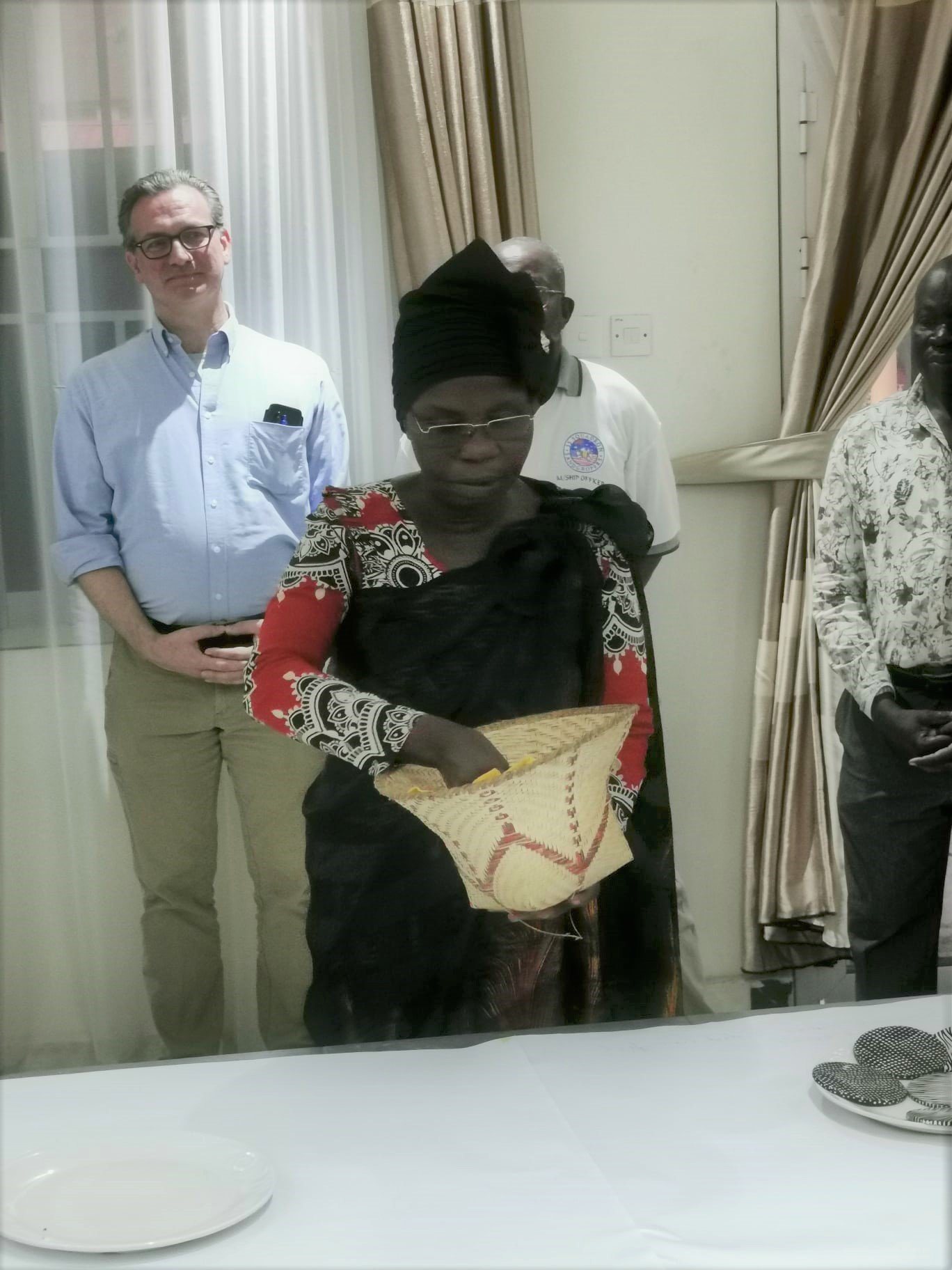
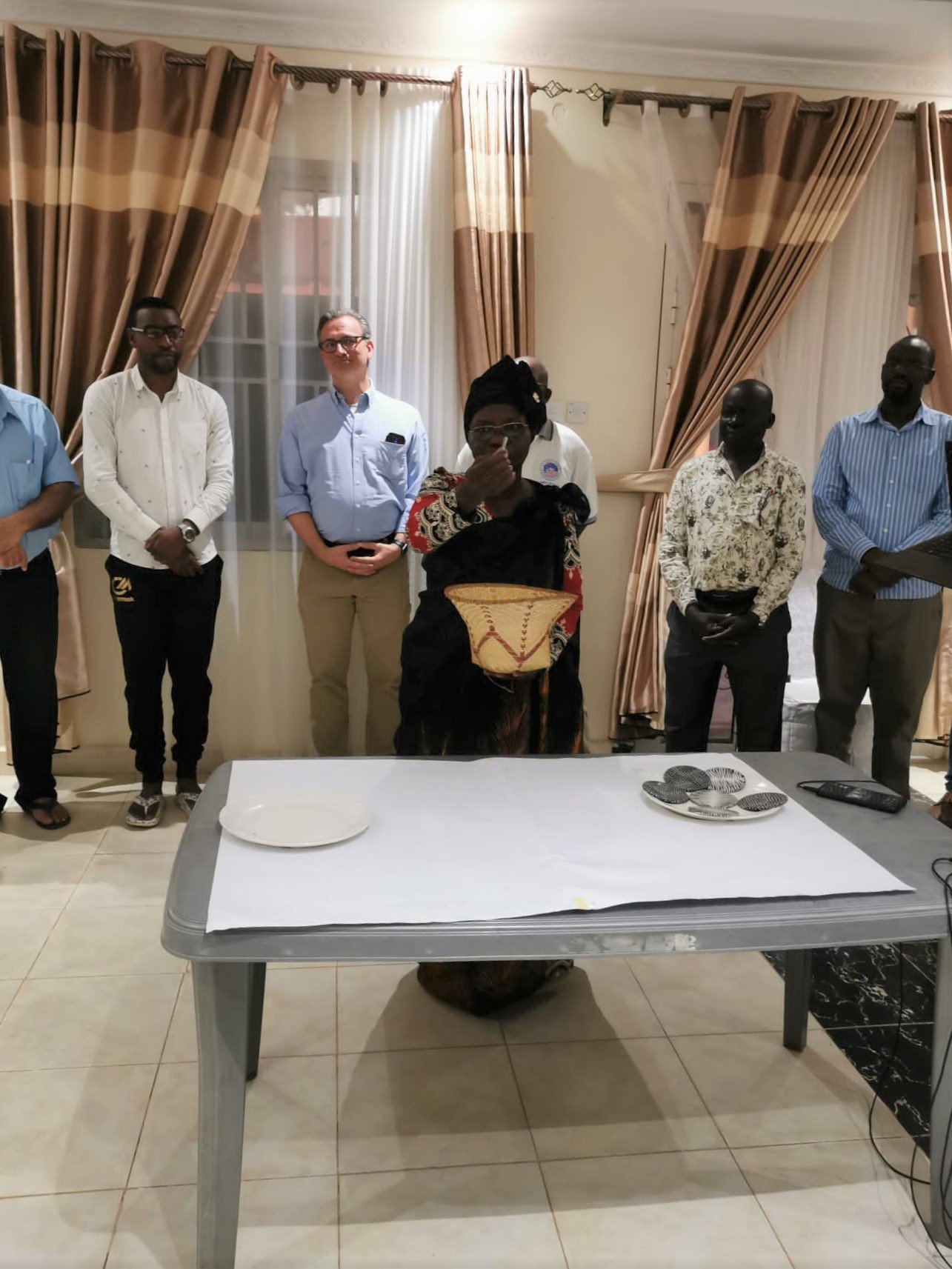
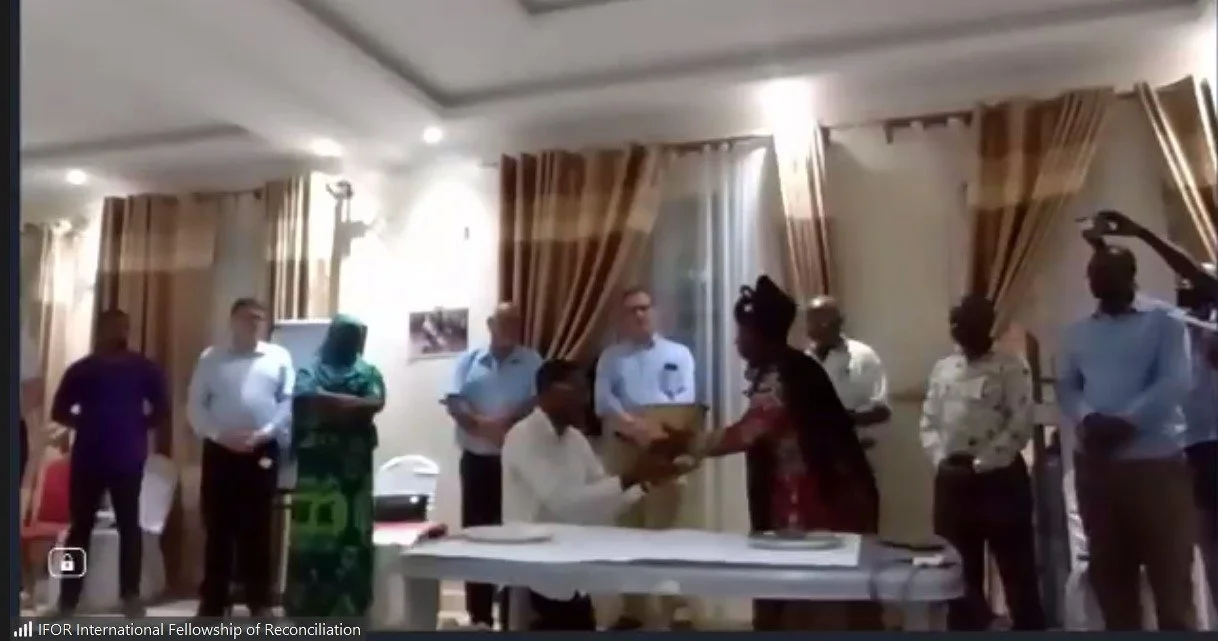
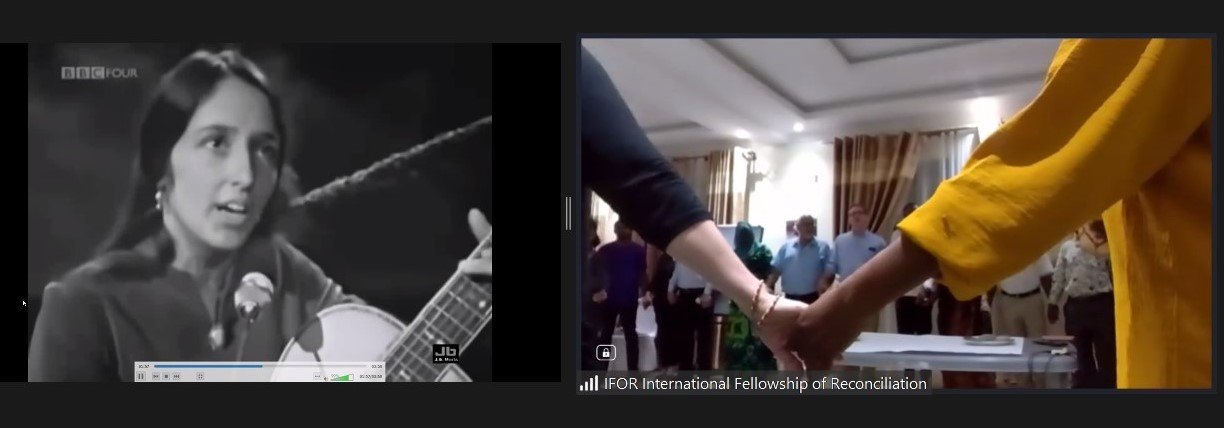
At the conclusion of the working sessions, on Sunday 20th, IFOR held a symbolic ceremony on "Colonialism" which was accompanied by a public statement.

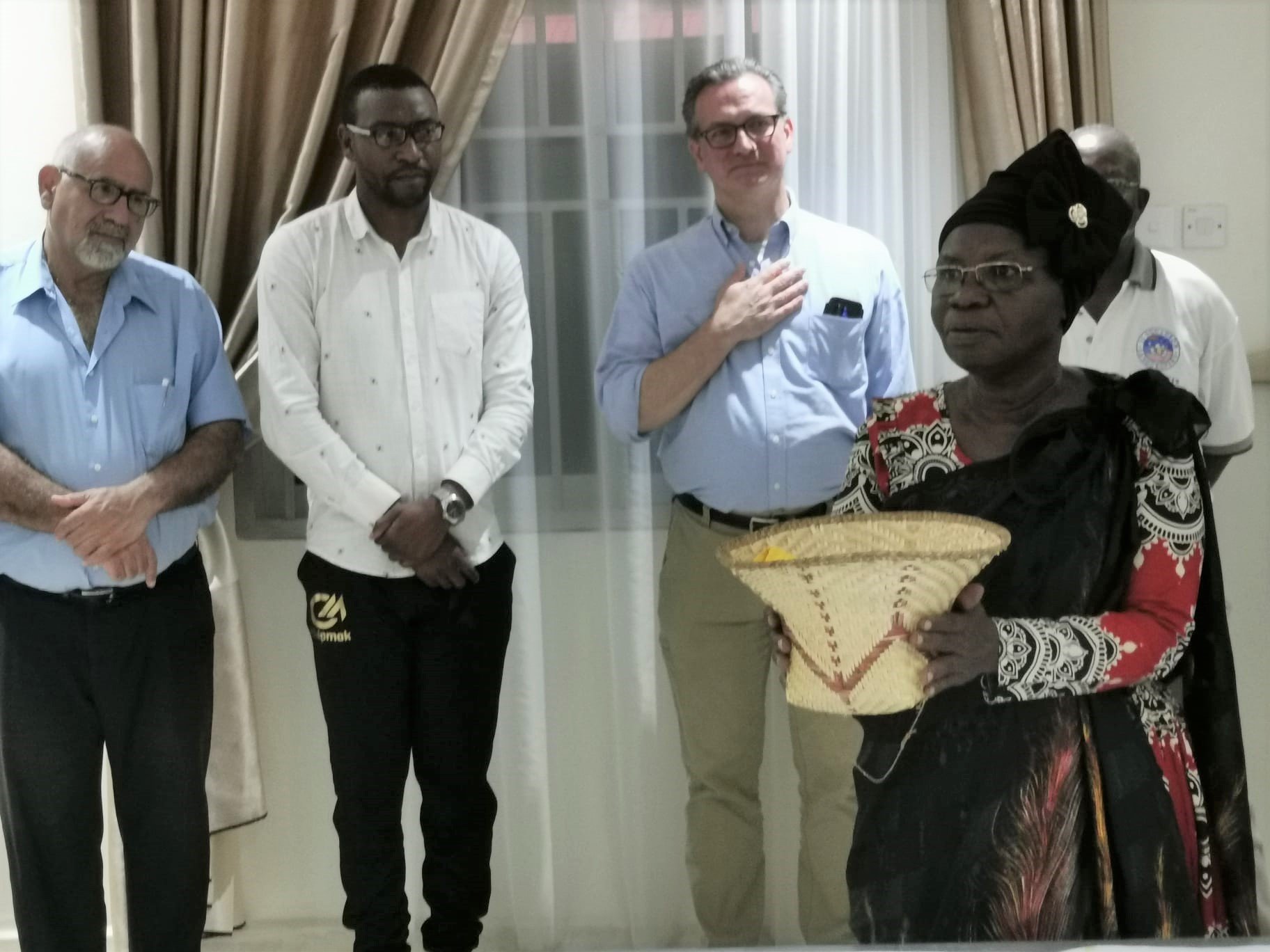
SYMBOLIC CEREMONY

Inside the African bowl there was a yellow shirt and a key.
Yellow is a color for optimism and hope. It also represents new beginnings, all of which are essential for any successful story of reconciliation and forgiveness.
The key represents the closing of the past and the opening of the future.
The woman that received the tokens represented the power of motherhood in pioneering peace, forgiveness and reconciliation in hostile environments.
The passing of those tokens to her children and their reception signified the transmission and acceptance of the message of peace, forgiveness and reconciliation and the will to take the bold step into new beginnings.


IFOR STATEMENT on COLONIALISM and AFRICA

Juba Council, 20 November 2022

Founded in response to the horrors of war in Europe, the International Fellowship Of Reconciliation has taken a consistent stance against war and its preparation throughout its history. IFOR members share a vision of a world where conflicts are resolved through nonviolent means, where systems that foster fear and hatred are dismantled, and where justice is sought as a basis for peace

Perceiving the need for healing and reconciliation in the world, the founders of IFOR formulated a vision of the human community based upon the belief that love in action has the power to transform unjust political, social, and economic structures

Having been established in 1914 and now with 71 branches, groups and affiliates in 48 countries on all continents, IFOR exists across spiritual and geographical boundaries. We therefore share the shame and the sinfulness of our European predecessors over the brutal colonization of Africa and all the evils that followed. And we offer our sincere, heartfelt and prayerful acknowledgment of these failures which are part of us, not just of some distant ‘them’.

We stand today on African soil here in Juba, South Sudan as peacemakers, seeking forgiveness and extending a hand of reconciliation. We seek to deepen our learning and response to the depths of colonialism, neocolonialism and all the violent effects brought about by these imperial systems. We are aware that for many on all sides, it can be difficult to look at these effects, to listen carefully to one another, and to empower those most affected to speak up. It is not easy to hold onto the depths of cruelty which the ideologies of racism and white supremacy have marked our cultures, divided our communities, and caused war and genocide. Yet as we feel the embrace of our hosts from the youngest country on the planet, the ideal of reconciliation feels more tangible and possible to us than ever before.

Our coming to Africa today, for the first time as a Council on this continent, is a major historic symbolic step of our acknowledgment and commitment to the rebuilding of healthy cooperative relationships between our sisters and brothers from Africa and the rest of our International. Our choice to hold the Council on African soil, and our actual arrival on this hospitable land, is no accident. No true internationalism can be built without the inclusion of all peoples of our rainbow earth.

Remembering and acknowledging the errors of the past also means a social call to name the injustice and to ensure that it is not repeated. Memories therefore shine lights on injustices, making them actionable. Our desire for reconciliation must not skip the task of social reparation and obscures the continuities of racism and white supremacy.

We are fully cognizant that this is just a step, perhaps a small initial step, but a right step into the journey of full trust, respect and mutual co-existence between the West, the East, and the African continent. This symbolic stage of action should inspire IFOR to develop a consensual program for future action, to translate our common will and commitment here into concrete future collaborations. In the context of the sins of our forefathers, and the hopes and dreams of all of us today as envisioned in our meetings and decisions made here, we believe these steps taken together will build a better fellowship both within our organization and in the communities we touch.

Click here to download it.


DÉCLARATION DE L'IFOR SUR LE COLONIALISME ET L'AFRIQUE

Conseil de Juba, 20 novembre 2022

Fondée en réponse aux horreurs de la guerre en Europe, le Mouvement international du la Réconciliation - MIR (International Fellowship of Reconciliation – IFOR) a adopté une position constante contre la guerre et sa préparation tout au long de son histoire.  Les membres de l'IFOR partagent une vision d'un monde où les conflits sont résolus par des moyens non violents, où les systèmes qui favorisent la peur et la haine sont démantelés et où la justice est recherchée comme base de la paix.

Percevant le besoin de guérison et de réconciliation dans le monde, les fondateurs de l'IFOR ont formulé une vision de la communauté humaine basée sur la conviction que l'amour en action a le pouvoir de transformer les structures politiques, sociales et économiques injustes.

Créé en 1914 et maintenant avec 71 branches, groupes et affiliés dans 48 pays sur tous les continents, le MIR existe au-delà des frontières spirituelles et géographiques.  Nous partageons donc la honte et le péché de nos prédécesseurs européens face à la colonisation brutale de l'Afrique et à tous les maux qui ont suivi.  Et nous offrons notre reconnaissance sincère, sincère et priante de ces échecs qui font partie de nous, pas seulement de quelques « eux » lointains.

Nous nous tenons aujourd'hui sur le sol africain ici à Juba, au Soudan du Sud, en tant qu'artisans de la paix, cherchant le pardon et tendant la main de la réconciliation.  Nous cherchons à approfondir notre apprentissage et notre réponse aux profondeurs du colonialisme, du néocolonialisme et de tous les effets violents provoqués par ces systèmes impériaux.  Nous sommes conscients que pour beaucoup de tous bords, il peut être difficile d'examiner ces effets, de s'écouter attentivement les uns les autres et de donner aux personnes les plus touchées les moyens de s'exprimer.  Il n'est pas facile de s'accrocher aux profondeurs de la cruauté que les idéologies du racisme et de la suprématie blanche ont marquées dans nos cultures, divisé nos communautés et provoqué guerres et génocides.  Pourtant, alors que nous sentons l'étreinte de nos hôtes du plus jeune pays de la planète, l'idéal de réconciliation nous semble plus tangible et possible que jamais auparavant.

Notre venue en Afrique aujourd'hui, pour la première fois en tant que Conseil sur ce continent, est une étape symbolique historique majeure de notre reconnaissance et de notre engagement à reconstruire de saines relations de coopération entre nos sœurs et frères d'Afrique et le reste de notre Internationale.  Notre choix de tenir le Conseil sur le sol africain, et notre arrivée effective sur cette terre hospitalière, n'est pas un hasard.  Aucun véritable internationalisme ne peut être construit sans l'inclusion de tous les peuples de notre terre arc-en-ciel.

Se souvenir et reconnaître les erreurs du passé signifie aussi un appel social à nommer l'injustice et à veiller à ce qu'elle ne se reproduise pas.  Les souvenirs mettent donc en lumière les injustices, les rendant exploitables.  Notre désir de réconciliation ne doit pas faire l'impasse sur la tâche de réparation sociale et occulter les continuités du racisme et de la suprématie blanche.

Nous sommes pleinement conscients qu'il ne s'agit que d'une étape, peut-être une petite étape initiale, mais une bonne étape dans le voyage de pleine confiance, de respect et de coexistence mutuelle entre l'Occident, l'Orient et le continent africain.  Cette étape symbolique de l'action devrait inspirer le MIR à développer un programme consensuel d'action future, pour traduire notre volonté et notre engagement communs ici en collaborations futures concrètes.  Dans le contexte des péchés de nos ancêtres, et des espoirs et des rêves de nous tous aujourd'hui, tels qu'ils sont envisagés dans nos réunions et décisions prises ici, nous croyons que ces mesures prises ensemble construiront une meilleure fraternité à la fois au sein de notre organisation et dans les communautés que nous toucher.

Cliquez ici pour télécharger.


DECLARACIÓN DEL MIR sobre el COLONIALISMO y ÁFRICA
Consejo de Yuba 20 de noviembre de 2022

Fundad o como respuesta a los horror e s de la g uerra en Europa, el Movimiento Internacional de Reconcilia-ción (MIR IFOR) mantiene a lo largo de su historia una postura consistente contra la guerra y su preparacióna. Las y los integrantes del MIR comparten la visión de un mucho en dónde los conflictos sean res ueltos a través de medios noviolentos, dónde se desmantelen los sistemas que fomentan el miedo y odio, y dónde se busque la justicia como base para la paz.

Percibiendo la necesidad de la sanación y reconciliaci ón en el mundo, los fundadores del MIR formu laron una visión de la comunidad humana, basada en la creencia que el amor en acción conlleva el poder de transformar las estructuras políticas, sociales y económicas injustas.

Establecido en el 1914, y ahora con 71 ramas, grupos y afiliados en 48 países e n todos los continentes, el MIR transciende las fronteras espirituales y geográficas. Compartimos así la sensación de vergüenza y la pecaminosidad de nuestros antecesores europeos con respecto a la colonización brutal de África y todos los males posteriores a los que ésta dio lugar. Y ofrecemos nuestro reconocimiento sincero, de corazón, y devoto de estos fracasos, que hacen parte de nosotros, en vez de pertenecer a un ‘ellos’ distante.

Nos encontramos hoy en suelo africano en Yuba, Sud án del Sur, como artesanas y artesanos de la paz, en búsqueda del perdón y con la mano de reconciliación extendida. Queremos profundizar nuestro aprendizaje y nuestra respuesta ante las profundidades del colonialismo, el neocolonialismo, y todos l os efectos violentos que acarrean estos sistemas imperiales. Somos conscientes de que, para muchos en todos los lados, resulta una tarea difícil mirar dichos efectos, escucharnos con cuidado los un os a los otros, y empoderar a la s personas más afectad a s, p ara que alcen la voz. No es fácil quedarse con las profundidades de crueldad que las ideologías del racismo y la supremacía blanca que han m arcado nuestras culturas, y provocado la guerra y el genocidio. No obstante, sintiendo el abrazo de nuestros anfitri ones d e este país el más joven del planeta la ideal de la reconciliación nos parece más tangible y posible que nunca jamás.

Nuestra venid a a África en estos días, por primera vez como Consejo en este continente, es un paso simbólico histórico significativo de nuestro reconocimiento y compromiso con la reconstrucción de relaciones sanas y cooperativas entre nuestros hermanos y hermanas de África, y el resto de nuestro Internacional. Nuestra decisión de convocar el Consejo en suelo africano, y n uestra llegada real en esta tierra acogedora, no es accidental. No es posible construir ningún internacionalismo verdadero sin la inclusión de todos los puebl os de nuestra tierra arcoíris.

Recordar y reconocer los errores del pasado, tambi én suponen un lla mado social a nombrar la injusticia y garantizar que nunca se repita. Por lo tanto, los recuerdos echan luces sobre las injusticias, volviéndolas objetos de acción. Nuestro deseo de reconciliación no puede pasar por alto la tarea de la reparación social, ni oscurecer la continu ación del racismo y la supremacía blanca.

Somos plenamente conscientes de que éste es un paso, tal vez s ólo un pequeño, primer paso; no obstante un paso correcto hacia el camino d e la confianza, el respeto, y la coexistencia mutua e ntre Occidente, Oriente y el continente africano. Esta fase simbólica de acción debe inspirar al MIR que desarrolle un programa consensuada de acción futura, para convertir nuestro deseo y compromiso comunes aquí en colaboraciones fu-turas concretas. En el contexto de los pecados de nuestros progenitores, y de las esperanzas y los sueños de todas y todos nosotros hoy, según nos imaginábamos en nuestras reun iones y decisiones aquí tomadas , creemos que estos pasos, tomados juntos, construirán una mayor fellows hip (fraternidad), tanto dentro de nuestra organización como en las comunidades que tocamos.

Haga clic aquí para descargarlo.

Comment